Why does adderall make me clench my jaw? Adderall causes jaw clenching — clinically known as bruxism — by overstimulating the central nervous system, raising muscle tension throughout the body including in the jaw muscles, and disrupting the sleep architecture during which most grinding and clenching occurs. It’s a direct pharmacological side effect of elevated dopamine and norepinephrine activity, not a sign of a separate problem. It is manageable, and for most people, fixable without stopping ADHD treatment.
Introduction
Jaw clenching and teeth grinding on Adderall is one of the most physically uncomfortable side effects of stimulant ADHD medication — and one of the least discussed. You might notice it during the day as a tight, sore jaw you can’t seem to relax, or wake up in the morning with aching jaw muscles and worn teeth you don’t remember grinding. Either way, it’s real, documented, and more common than most prescribers mention.
This guide explains exactly why Adderall causes jaw clenching, what specific mechanisms are driving it in your case, what the long-term dental risks are if it goes unmanaged, and — critically — what actually stops it.
What You Need to Know First
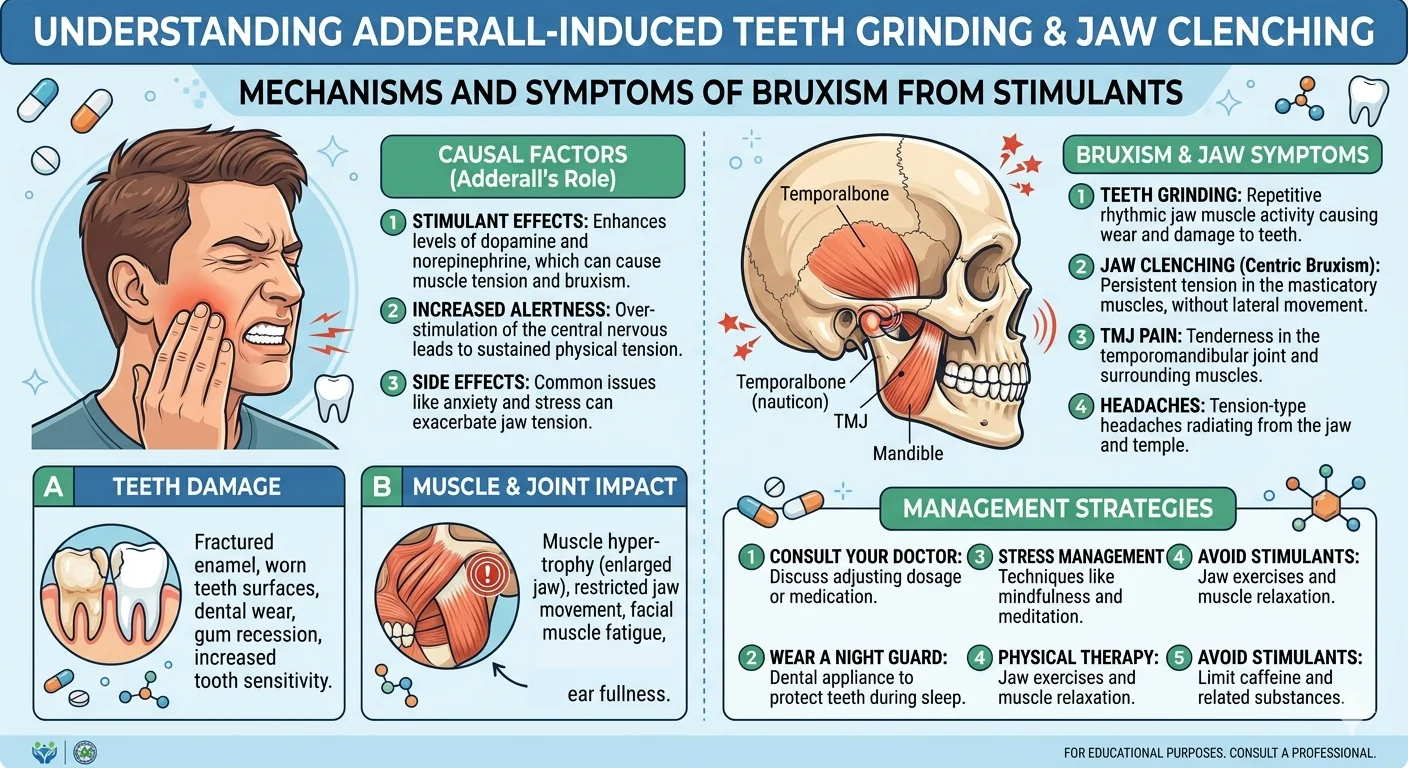
The clinical term for Adderall-induced jaw clenching and teeth grinding is bruxism — defined as repetitive jaw-muscle activity involving clenching or grinding of the teeth. Bruxism can occur while awake (awake bruxism) or during sleep (sleep bruxism), and Adderall can trigger both.
Adderall does not cause bruxism in everyone — but the risk is significantly elevated compared to the general population. A systematic review of drug-induced bruxism confirmed that stimulant medications including amphetamine-based drugs are among the most documented pharmaceutical triggers.
Key facts:
- Jaw clenching on Adderall is a known, documented side effect — it’s bruxism triggered by stimulant pharmacology
- Both daytime clenching (awake bruxism) and nocturnal grinding (sleep bruxism) can occur
- Dose is a primary driver — higher doses are more likely to cause and worsen jaw clenching
- Left unmanaged, it can cause serious dental damage — enamel erosion, cracked teeth, and TMJ disorders
- Multiple effective management strategies exist that do not require stopping ADHD treatment
- The same effect occurs with Vyvanse and dexamphetamine — it is a class effect of amphetamine-based stimulants, not unique to Adderall
Why Adderall Causes Jaw Clenching: The Mechanisms
There are three interconnected pathways through which Adderall produces bruxism. Understanding all three clarifies why different management strategies work — and which one applies most to your situation.
1. Elevated Muscle Tension From Sympathetic Nervous System Activation
Adderall raises norepinephrine, which activates the sympathetic (“fight-or-flight”) nervous system throughout the body. One consistent physiological consequence of sympathetic activation is increased global muscle tone — the body enters a state of readiness that expresses itself as muscular tension from head to foot.
The jaw muscles — the masseter, temporalis, and pterygoid muscles — are particularly sensitive to this systemic tension increase. Under normal stress-free conditions, these muscles relax completely. Under stimulant-driven sympathetic activation, they remain in a state of partial contraction — like an engine idling too hard at a red light, as one dental practitioner described it. This partial contraction persists across the day and into sleep, producing both daytime clenching and nocturnal grinding.
2. Dopamine Dysregulation and the Brain’s Search for an Outlet
When Adderall raises dopamine and norepinephrine above the level the brain can comfortably process, the nervous system seeks physical outlets for the excess stimulation. The jaw’s repetitive clenching and grinding is one such outlet — a way for the brainstem to discharge excess motor activation that has nowhere else to go.
This mechanism is particularly active during sleep, when the brain is in a state of reduced cortical inhibition and the brainstem’s motor discharge patterns are less regulated. If Adderall’s stimulant activity has not cleared the system before sleep onset — which commonly occurs with XR taken too late, or with doses that have extended half-lives in slower metabolisers — the brainstem continues releasing motor activations through the night, producing sustained sleep bruxism.
3. Anxiety Amplification and Stress-Pathway Activation
Adderall’s norepinephrine-raising effects amplify existing anxiety and stress pathways — and anxiety is one of the strongest independent drivers of bruxism. In people with co-occurring anxiety (which, as noted in the previous article, affects approximately 50% of adults with ADHD), the two effects compound each other: the stimulant raises physiological arousal, the anxiety raises it further, and the jaw muscles absorb the combined tension output.
This explains why jaw clenching on Adderall is frequently worse on stressful days, during demanding work periods, and during the crash window — all points where anxiety and residual stimulant activation coincide.
Awake Bruxism vs. Sleep Bruxism: Key Differences
Understanding which type of bruxism you’re experiencing shapes the most effective management approach:
The Long-Term Dental and Jaw Risks of Unmanaged Bruxism
This is the part most patients don’t hear until the damage is already visible — and it warrants direct, honest communication. Left unmanaged over months to years, Adderall-related bruxism can produce:
- Enamel erosion — grinding progressively removes the outer enamel layer from teeth, which does not regenerate. Thinned enamel increases sensitivity, cavity risk, and eventual structural vulnerability
- Cracked and fractured teeth — sustained clenching forces exceed what many teeth can withstand, producing stress fractures that can require crowns, root canals, or extraction
- TMJ disorders — the temporomandibular joint absorbs the force of every clench. Sustained bruxism inflames the joint, produces clicking and popping, limits jaw movement range, and can cause chronic jaw and facial pain
- Headaches — the masseter and temporalis muscles attach to the skull. Chronic tension in these muscles produces tension headaches that originate from jaw-related strain, often misattributed to other causes
- Dry mouth and increased decay risk — Adderall independently reduces saliva production, and reduced saliva removes a key protection against bacteria and acid erosion. Combined with bruxism-induced enamel thinning, cavity risk increases substantially
The University of Washington’s School of Dentistry explicitly flags Adderall patients as requiring dental monitoring for these specific complications. If you’ve been on stimulant ADHD medication for more than a year without a dental review, one is clinically warranted.
What Actually Fixes Adderall Jaw Clenching
These strategies are ordered from immediately actionable to those requiring prescriber involvement:
1. Physical Awareness — The Zero-Cost Immediate Step
Many people who clench their jaw on Adderall are not fully aware they’re doing it — the medication’s focus-intensifying effect reduces interoceptive awareness (the brain’s ability to notice internal body sensations). The first step is simply developing the habit of checking your jaw position periodically during the day. The jaw at rest should have teeth slightly apart, lips closed, with no muscular tension. If you find your teeth touching when you check — you’re clenching.
Setting a periodic phone reminder to “check and release jaw” during medicated work periods is a practical and surprisingly effective behavioural intervention for awake bruxism.
2. Magnesium Supplementation
Magnesium is a natural muscle relaxant that directly counteracts the muscle-tension-raising effects of stimulant medications. The most widely reported and practically effective non-prescription intervention for Adderall jaw clenching in patient communities is magnesium glycinate — a form with high bioavailability and low gastrointestinal side effects.
The mechanism is direct: magnesium regulates calcium at the neuromuscular junction, reducing the excitatory muscle activation that Adderall’s norepinephrine elevation produces. Taken in the evening — typically 200–400mg magnesium glycinate — it helps reduce overnight grinding in addition to daytime jaw tension. Discuss dosing with a GP or pharmacist, particularly if you have kidney disease or are on other medications.
3. Night Guard — Essential for Sleep Bruxism
A custom-fitted night guard from a dentist is the most clinically robust protection against sleep bruxism damage. It does not stop the clenching or grinding behaviour — but it distributes the force across a protective surface rather than allowing it to concentrate on tooth enamel and the TMJ.
Custom-fitted guards (from a dentist) are significantly more effective than over-the-counter options — they are precisely calibrated to your bite and do not produce the compensatory clenching that ill-fitting guards can trigger. If you’re on long-term stimulant ADHD medication and experiencing any jaw symptoms, a dental consultation and custom guard is a direct investment in preventing the long-term damage described above.
4. Adjust Dosing Timing — Earlier Is Better
For sleep bruxism specifically, the most effective prescription-level intervention is taking Adderall earlier in the day to ensure it has cleared the system before sleep. Adderall IR taken after noon, and XR taken after 9 AM, frequently produces stimulant activity that has not fully resolved at sleep onset — keeping the brainstem in a state of partial activation that drives nocturnal grinding.
Moving the dose to 7–8 AM and taking IR rather than XR where possible reduces the likelihood of residual stimulant activity at bedtime. This also improves sleep quality independently — which is a separate contributor to bruxism risk.
5. Dose Reduction
Because bruxism severity is dose-dependent — higher doses produce more pronounced sympathetic activation and therefore more jaw tension — a modest dose reduction frequently reduces jaw clenching measurably. This is particularly true for patients whose current dose may be at the higher end of their therapeutic range or above it.
Discuss with your prescriber: if jaw clenching is significant, painful, or producing dental consequences, it’s a legitimate clinical reason to trial a lower dose and assess whether ADHD symptom control is maintained adequately.
6. Warm Compresses and Jaw Relaxation Exercises
For acute jaw pain and muscle tension during or after the medication’s active window, warm compresses applied to the masseter (the muscle just in front of and below the ear) provide direct muscular relief. Gentle jaw stretching exercises — slowly opening the jaw fully, holding, and releasing — can interrupt tension build-up during long medicated work sessions.
7. Address Co-occurring Anxiety
If anxiety is a significant component of your jaw clenching — if it consistently worsens on stressful days or periods — treating the anxiety directly is the most targeted upstream intervention. This may include cognitive-behavioural therapy, mindfulness-based stress reduction, or pharmacological anxiety management — all of which can be discussed with a prescriber in the context of your full ADHD and anxiety picture.
8. Muscle Relaxants (If Clinically Warranted)
For severe sleep bruxism that is producing significant pain or dental damage despite the above measures, a prescriber may consider a low-dose muscle relaxant taken at bedtime. This is not a first-line intervention — it’s reserved for cases where other approaches have not provided adequate relief and the bruxism is causing clinical harm. Discuss with your GP or prescribing specialist.
The Caffeine and Stimulant Stacking Warning
Caffeine, nicotine, and other stimulants activate the same sympathetic nervous system pathways that drive Adderall-related jaw tension. Consuming significant amounts of caffeine alongside Adderall amplifies total sympathetic activation — and with it, jaw muscle tension and bruxism risk. If jaw clenching is a problem on your current medication, high caffeine intake (more than 1–2 cups of coffee per day) is a direct aggravating factor worth eliminating before escalating to other interventions.
Safety and Legal Context for Australians
Adderall is not available in Australia — it is not TGA-approved and cannot be legally prescribed. The jaw clenching mechanisms, risks, and all management strategies described in this article apply equally to Vyvanse (lisdexamfetamine) and dexamphetamine, Australia’s TGA-approved amphetamine-based ADHD medications. Jaw clenching is explicitly recognised as a side effect of Vyvanse — the same sympathetic activation pathway, the same bruxism mechanism, the same solutions.
Australian patients experiencing significant jaw clenching on any stimulant ADHD medication should raise it with their prescribing specialist and — importantly — their dentist, who can assess for early enamel damage and fit a night guard before damage accumulates. Dental monitoring is a clinically appropriate part of long-term stimulant ADHD treatment, particularly for patients on higher doses.
Common Misconceptions About Adderall Jaw Clenching
Myth 1: “Jaw clenching on Adderall is harmless — just a minor inconvenience.”Unmanaged, it is not minor. Chronic bruxism produces progressive enamel erosion that is irreversible, cracked teeth that can require extensive restorative dentistry, TMJ disorders that can produce chronic jaw and facial pain, and daily headaches. Treating it as a nuisance to ignore rather than a dental health concern to manage actively is the primary reason patients end up with significant dental bills years into ADHD treatment.
Myth 2: “If I clench my jaw on Adderall, the dose is definitely too high.”Jaw clenching can occur at therapeutic doses in susceptible individuals — dose is a driver but not the only one. Individual variation in sympathetic reactivity, co-occurring anxiety, caffeine intake, sleep quality, and medication timing all contribute. A dose review may help, but addressing timing, magnesium, caffeine, and a night guard often resolves the issue without any dose change.
Myth 3: “A night guard will stop the clenching.”A night guard prevents the damage from clenching — it does not stop the clenching itself. It’s a protective device, not a curative one. To actually reduce the frequency and force of bruxism behaviour, the upstream interventions — timing adjustment, dose review, magnesium, anxiety management — are needed alongside the guard.
Myth 4: “Only people who clench during the day have this problem.”Sleep bruxism is arguably the more clinically significant form because it occurs without conscious awareness and can continue for hours through the night. Many patients with significant Adderall-related enamel damage were not aware they were grinding at all until a dentist flagged it during a routine check — by which point meaningful enamel loss had already occurred.
FAQ — Why Does Adderall Make Me Clench My Jaw?
Why does Adderall specifically cause jaw clenching?Adderall raises dopamine and norepinephrine, activating the sympathetic nervous system and increasing global muscle tension — including in the jaw muscles. The brainstem also discharges excess motor activation through repetitive jaw movements when stimulant levels are higher than the system can smoothly process. Both mechanisms converge on the jaw, producing clenching during the day and grinding during sleep.
Is Adderall jaw clenching the same as bruxism?Yes — “Adderall jaw clenching” and bruxism describe the same phenomenon. Bruxism is the clinical term for repetitive jaw-muscle activity involving clenching or grinding of the teeth. Adderall is a documented pharmaceutical trigger for bruxism, and stimulant-induced bruxism shares the same clinical management approach as bruxism from other causes.
Does Adderall jaw clenching go away on its own?For some people, it moderates as the body adapts to the medication in the first weeks of treatment — as with other stimulant side effects. For others, particularly those on higher doses or with co-occurring anxiety, it persists and can worsen over time without intervention. If jaw clenching has been present beyond two weeks at a consistent level, don’t wait — the dental consequences of prolonged unmanaged bruxism make prompt management the right approach.
Does magnesium actually help with Adderall jaw clenching?Magnesium is the most consistently reported effective supplement for this purpose in clinical contexts and ADHD patient communities. Magnesium acts as a natural muscle relaxant by regulating calcium at the neuromuscular junction, reducing the excitatory muscle activation that stimulant-driven norepinephrine elevation produces. Magnesium glycinate is generally preferred for its bioavailability and low GI side effects. While large-scale randomised trials specifically on Adderall bruxism and magnesium are limited, the mechanism is well-established and the safety profile at standard supplemental doses is excellent.
Should I get a night guard for Adderall jaw clenching?If you’re experiencing any sleep bruxism symptoms — jaw pain on waking, headaches in the morning, partner reports of grinding sounds, or dental sensitivity — a custom-fitted night guard from a dentist is strongly recommended. It prevents enamel damage and TMJ strain that accumulate silently over years of unmanaged sleep grinding. Custom-fitted guards from a dentist are meaningfully superior to pharmacy options — they don’t produce compensatory clenching and are calibrated to your specific bite.
Does stopping Adderall stop the jaw clenching?For most people, yes — jaw clenching that is pharmacologically driven by Adderall’s stimulant effect resolves when the medication is stopped or significantly reduced. However, if bruxism has been present long enough to produce learned neuromuscular patterns or TMJ changes, some residual tendency may persist and warrant continued dental monitoring. For patients who cannot or do not want to stop ADHD treatment, the management strategies above — particularly timing, dose review, magnesium, and night guard — address the bruxism without discontinuing the medication.
Is jaw clenching worse at night or during the day on Adderall?This varies by individual. Patients on XR or late-dose IR frequently experience more pronounced sleep bruxism, as residual stimulant activity during sleep drives nocturnal motor discharge. Patients on earlier IR doses with good medication clearance by bedtime may predominantly experience awake bruxism during periods of intense focus. Many experience both, with the daytime clenching more noticeable (as it’s felt in real time) but the nighttime grinding potentially more damaging.
The Bottom Line
Adderall causes jaw clenching through a well-understood pharmacological mechanism: sympathetic nervous system activation raises global muscle tension, the jaw muscles are particularly susceptible, and sleep bruxism occurs when stimulant activity hasn’t fully cleared before sleep. The consequences of leaving it unmanaged are real and cumulative — progressive enamel erosion, cracked teeth, TMJ disorders, and chronic headaches are documented outcomes of long-term untreated bruxism. The good news is that the most effective interventions — magnesium supplementation, earlier dosing, a custom night guard, and periodic jaw relaxation — can be implemented immediately, address the issue at its source, and do not require stopping ADHD treatment. For Australian patients on Vyvanse or dexamphetamine experiencing the same jaw symptoms, the identical solutions apply — raise it with both your prescribing specialist and your dentist.
Why does Adderall make me clench my jaw Hobart
Why does Adderall make me clench my jaw Devonport
Why does Adderall make me clench my jaw Launceston
Why does Adderall make me clench my jaw Tasmania
Why does Adderall make me clench my jaw Victoria
Why does Adderall make me clench my jaw Queensland
Why does Adderall make me clench my jaw Canberra
Why does Adderall make me clench my jaw Australian Capital Territory
Why does Adderall make me clench my jaw South Australia
Why does Adderall make me clench my jaw New South Wales
Why does Adderall make me clench my jaw Darwin
Why does Adderall make me clench my jaw Ghan
Why does Adderall make me clench my jaw Northern Territory
Why does Adderall make me clench my jaw Australia
Why does Adderall make me clench my jaw Austria
Why does Adderall make me clench my jaw Germany
Why does Adderall make me clench my jaw United Kingdom
Why does Adderall make me clench my jaw Sweden
Why does Adderall make me clench my jaw Denmark
Why does Adderall make me clench my jaw Norway
Why does Adderall make me clench my jaw Finland
Why does Adderall make me clench my jaw Iceland
Why does Adderall make me clench my jaw Netherlands
Why does Adderall make me clench my jaw Spain
Why does Adderall make me clench my jaw Ireland
Why does Adderall make me clench my jaw Switzerland