
what does adderall do for adhd? For people with ADHD, Adderall corrects a chronic dopamine and norepinephrine deficit in the brain — restoring attention, reducing impulsivity, and calming hyperactivity by bringing neurotransmitter activity up to a functional baseline. Unlike its effects in neurotypical people, Adderall does not overstimulate an ADHD brain. Instead, it produces focus, clarity, and a sense of calm that many people with ADHD have never experienced before.
Introduction
If you’ve recently been diagnosed with ADHD — or a child or family member has — “what does Adderall do for ADHD” is one of the most important questions you can ask before starting treatment. Not because the answer is complicated, but because misunderstanding it leads to unrealistic expectations, poor dosing decisions, and confusion when the medication doesn’t behave the way you assumed.
This guide explains the mechanism clearly, walks through what symptom improvement actually looks like in practice, covers the evidence base behind the drug, and addresses what Australians in particular need to know — since Adderall itself is not available here, but closely related medications are.
What You Need to Know First
ADHD is not a focus problem caused by laziness or poor effort. It is a neurological condition characterised by chronically underactive dopamine signalling — particularly in the prefrontal cortex, the brain region responsible for planning, impulse control, decision-making, and sustained attention. Because the dopamine system is under-stimulated, the ADHD brain constantly seeks alternative stimulation — which presents as restlessness, distractibility, impulsivity, and difficulty completing tasks that aren’t immediately engaging.
Adderall was specifically developed to correct this deficit. It contains a precise mixture of four amphetamine salts: dextroamphetamine saccharate, amphetamine aspartate monohydrate, dextroamphetamine sulfate, and amphetamine sulfate — each contributing to a sustained and balanced amphetamine release profile.
Key facts about Adderall and ADHD:
- Works by increasing dopamine and norepinephrine levels in the brain, especially in the prefrontal cortex
- Approved for ADHD in children aged 3 and older, adolescents, and adults
- Effective in approximately 75–90% of children with ADHD when properly dosed
- Comes in two forms: Adderall IR (4–6 hours) and Adderall XR (up to 12 hours)
- Onset of effects: 30–60 minutes after taking the dose
- Treats all three ADHD presentations: inattentive, hyperactive-impulsive, and combined type
How Does Adderall Actually Help an ADHD Brain?
Adderall works through two simultaneous actions: it blocks the reuptake of dopamine and norepinephrine (keeping them active in the synapse longer), and it stimulates the direct release of these neurotransmitters from nerve terminals. Together, these effects raise neurotransmitter concentrations in the prefrontal cortex — the region most impaired by ADHD — bringing activity closer to what it would be in a non-ADHD brain.
Groundbreaking 2025 research from Washington University Medicine added a nuanced layer to this picture: stimulant ADHD medications appear to work primarily by making tasks feel more rewarding and interesting — not by directly “lighting up” attention circuitry. In other words, Adderall doesn’t force the brain to pay attention. It makes the task at hand feel worth paying attention to, which is how sustained focus becomes possible.
This distinction matters clinically: Adderall works best when the environment supports it — when there’s a clear task, structured time, and a low-distraction setting. It amplifies the brain’s natural motivation system rather than overriding it.
What Symptoms Does Adderall Actually Improve?
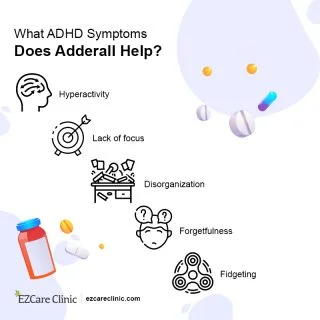
Adderall targets the core ADHD symptom clusters directly. Based on clinical evidence and extensive patient reporting, here is what consistent improvement looks like in practice:
Attention and focus:
- Ability to start and stay on tasks that were previously impossible to begin
- Reduced mind-wandering during conversations, lectures, or reading
- Improved working memory — holding information mid-task without losing it
Impulsivity control:
- Less blurting out in conversations
- Improved ability to pause before acting or responding
- Fewer impulsive decisions in financial, social, or professional contexts
Hyperactivity reduction:
- Physical restlessness decreases noticeably — less fidgeting, pacing, or need to constantly move
- For many adults, this presents as an internal quieting — the mental noise and “racing thoughts” slow down significantly
Executive function improvements:
- Better task prioritisation and planning
- Improved time management and follow-through on multi-step tasks
- Reduced procrastination — especially on low-interest but necessary tasks
Many patients describe the first effective dose as feeling like “going from a hurricane to a calm, sunny lake” inside their head. That phrase comes up repeatedly and captures something clinical language alone doesn’t: it’s not just about focus, it’s about finally being able to be still.
How Long Does It Take for Adderall to Work for ADHD?
Adderall IR typically begins working 30 to 60 minutes after taking it, with peak effects between 1 and 3 hours and a full duration of 4 to 6 hours. Adderall XR uses a dual-bead delivery system — 50% releases immediately, 50% releases approximately 4 hours later — providing up to 12 hours of coverage from a single morning dose.
For ADHD specifically, when is it “working”? You’ll know Adderall is effective when you can complete tasks you normally find boring, control impulsive behaviours more consistently, listen in conversations without your mind wandering, and sit through something demanding without the need to escape or fidget. These aren’t subtle effects — for most people with ADHD, the difference between a medicated and unmedicated day is significant and immediately noticeable.
Dose titration — starting low and gradually increasing — is the standard approach because the right dose is highly individual. Too low a dose produces no noticeable change. Too high causes anxiety, racing heart, and irritability. Getting the dose right usually takes 2–6 weeks of adjustments with a prescriber.
Does Adderall Work for All Three Types of ADHD?
Yes — Adderall has demonstrated clinical efficacy across all three ADHD presentations.
For severe inattentive symptoms specifically, research suggests amphetamine-class medications like Adderall and Vyvanse perform moderately better than methylphenidate (Ritalin) — with a 2018 meta-analysis of 8,000 adults finding amphetamines produced superior results after 12 weeks of treatment.
What the Clinical Evidence Says
The evidence base behind Adderall for ADHD is extensive and robust. A landmark NIH meta-analysis confirmed that Adderall significantly improved outcomes for people with ADHD compared to placebo, regardless of dose type, measurement method, or rater. A Johns Hopkins study showed that both Adderall and methylphenidate produce improvements “well into the normal range” for the majority of patients — not just marginal gains.
More recently, children with ADHD who took stimulant medication showed better grades and improved performance on standardised cognitive tests compared to unmedicated peers — and critically, this cognitive benefit appeared exclusively in participants with ADHD, not in neurotypical controls. This directly reinforces the core mechanism: Adderall corrects a deficit unique to the ADHD brain. It is not a performance enhancer for people who don’t have ADHD — it is a therapeutic corrective for people who do.
Practical Application: Maximising Adderall’s Effectiveness for ADHD
From clinical experience and what ADHD patients consistently report, these practical factors make a significant difference in how well Adderall performs:
- Take it at a consistent time each morning. Irregular timing undermines the stable blood-level consistency that makes Adderall predictable
- Avoid high-fat meals at the time of dosing. A high-fat breakfast can delay Adderall IR absorption by 2–3 hours; a light meal or taking it before eating is preferable
- Combine with behavioural strategies. Adderall opens the window for better executive function — but structure, CBT, and ADHD coaching turn that window into real-world results
- Don’t take afternoon doses too late. Adderall IR taken after 3 PM will frequently disrupt sleep, which then undermines next-day performance regardless of medication
- Track symptoms, not just feelings. Many ADHD patients on correct doses report the medication “isn’t working” because they expected to feel something dramatic. Use a simple daily log of task completion and impulsive incidents rather than relying on subjective feeling alone
Trade-Offs and Honest Limitations
Adderall is highly effective for ADHD — but it is not without trade-offs that every patient should understand before starting:
- Appetite suppression is significant, particularly in children. Weight monitoring and ensuring adequate nutrition outside of peak-medication hours is essential
- Sleep disruption is common when dosing or timing isn’t calibrated correctly — and poor sleep actively counteracts ADHD treatment gains
- Emotional blunting is reported by some patients — a flattening of mood or reduced spontaneity that, while not universal, is worth discussing with a prescriber if it occurs
- Withdrawal-like crash occurs as the drug wears off — a dip in focus and mood that some patients find difficult to manage, particularly in after-school or after-work hours
- Not a permanent fix. Adderall manages symptoms while it’s active. It does not rewire the brain or produce lasting changes after treatment stops
The trade-off framing that’s most useful: the focus gains are real and clinically significant, but appetite and sleep management require active attention — especially in children during growth periods.
Safety and Legal Status in Australia
Adderall is not available in Australia. It is not TGA-approved and cannot be legally prescribed or dispensed by Australian healthcare providers. For Australians with ADHD, the equivalent medications — sharing the same or closely related active ingredients — are:
- Dexamphetamine — contains dextroamphetamine, the primary active component of Adderall; available by specialist prescription
- Lisdexamfetamine (Vyvanse) — a prodrug that converts to dextroamphetamine in the body; PBS-listed and widely considered to have a smoother, lower-misuse-risk profile than Adderall
- Methylphenidate (Ritalin, Concerta, Ritalin LA) — a different stimulant class; also first-line for ADHD in Australia
- Non-stimulants (Atomoxetine, Guanfacine) — for patients who cannot tolerate or do not respond to stimulants
All ADHD medications in Australia require a specialist prescription — a psychiatrist, paediatrician, or authorised prescriber — not a GP in most states. Attempting to import Adderall from overseas requires prior TGA approval, and possession without a valid Australian prescription carries serious legal consequences.
Common Misconceptions About Adderall and ADHD
Myth 1: “If Adderall calms you down, that confirms you have ADHD.”This is one of the most persistent myths in ADHD discourse — and it’s medically inaccurate. Adderall stimulates dopamine release in everyone’s brain. At low doses, even neurotypical people can feel calmer due to mild arousal regulation. The calming effect is a dose phenomenon, not a diagnostic marker. Self-testing with stimulants to “see if you have ADHD” is unreliable and potentially dangerous.
Myth 2: “Adderall will make my child dependent or addicted.”When used as prescribed at therapeutic doses under medical supervision, the risk of addiction is significantly lower than in unsupervised use. Multiple studies suggest that treating ADHD with stimulants actually reduces the long-term risk of substance use disorders — possibly because untreated ADHD is itself a risk factor for self-medication. That said, dependence risk is real and warrants proper monitoring.
Myth 3: “Adderall should make you feel focused all day, every day.”Adderall works within its active window — 4–6 hours for IR, up to 12 for XR. Outside those windows, ADHD symptoms return to baseline. This is normal, expected, and by design. Some patients need to adjust their dose timing or switch to XR to get consistent coverage; others deliberately choose IR to have medication-free evenings.
FAQ — Questions People Also Ask
Does Adderall work immediately for ADHD?Yes — at the right dose, most people with ADHD notice meaningful improvement on the first day. Adderall IR typically kicks in within 30–60 minutes. The challenge is finding the right dose, which takes titration over several weeks. The first dose you try may be too low to feel a noticeable effect, but that’s a calibration issue, not a sign it won’t work.
How do I know if Adderall is working for my ADHD?The clearest signs are: being able to complete boring or difficult tasks without abandoning them, improved ability to listen without your mind drifting, fewer impulsive actions or words, and a reduction in internal mental noise. Many patients also report improved mood stability and lower anxiety as a secondary benefit. If you’re feeling jittery, anxious, or euphoric, the dose is likely too high.
Is Adderall better than Ritalin for ADHD?Both are first-line stimulant treatments with strong evidence bases. Amphetamine-based medications like Adderall tend to outperform methylphenidate (Ritalin) for adults with severe inattentive symptoms, based on meta-analysis data. But individual response varies significantly — some people do better on methylphenidate. The right medication is the one that works for your specific neurobiology with the fewest side effects, which typically requires trying both under clinical guidance.
Does Adderall help ADHD in adults the same way it helps children?The core mechanism is identical — dopamine and norepinephrine correction. But adults and children differ in how ADHD presents and what they need from medication. Adults typically present with more inattention and executive dysfunction than overt hyperactivity. Dosing also differs — adults generally require higher doses to achieve equivalent symptom control, and cardiovascular monitoring is more important as people age.
Can Adderall stop working over time?Tolerance to Adderall’s therapeutic effects is less common than many patients fear — but it does happen. What’s more often described as “tolerance” is actually a dosing mismatch due to weight changes, age, hormonal shifts, or changes in sleep quality and stress levels. True pharmacological tolerance — needing ever-increasing doses for the same effect — is more associated with misuse than therapeutic use. If Adderall seems to have stopped working, discussing dose or formulation adjustments with your prescriber is the right step.
What happens when Adderall wears off in ADHD?As the medication clears the system, dopamine levels drop back to their ADHD baseline — and ADHD symptoms return. Some patients also experience a brief “rebound” period where symptoms temporarily feel more intense than pre-medication, particularly with IR formulations. This rebound effect is more common in children and is often managed by timing the last dose strategically, switching to XR, or adding a small afternoon IR booster under medical supervision.
Is it safe to take Adderall for ADHD long-term?For most people with ADHD, long-term stimulant treatment is considered safe under medical supervision. Regular cardiovascular check-ins, weight and growth monitoring in children, and periodic “drug holidays” — brief planned breaks, often during school holidays — help manage side effects and preserve the medication’s effectiveness. The decision to continue long-term should involve regular review with a treating specialist.
Does Adderall help with ADHD-related anxiety?This is nuanced. ADHD and anxiety frequently co-occur, and there are two distinct patterns. If anxiety is driven by ADHD symptoms — the constant stress of forgetting things, under-performing, and struggling to manage daily tasks — Adderall can reduce that anxiety by resolving the ADHD. But if someone has an independent anxiety disorder alongside ADHD, Adderall can worsen it. Co-existing anxiety is one of the most important factors to discuss with your prescriber before starting stimulant treatment.
The Real Takeaway
For people with ADHD, Adderall does something that no amount of effort or willpower can replicate: it corrects a neurochemical deficit that makes basic daily functioning unnecessarily hard. The clinical evidence is strong, the response rate is high, and the improvement — for those who respond — is meaningful and life-changing. For Australians, the path to this treatment runs through TGA-approved equivalents like Vyvanse and dexamphetamine, all requiring specialist oversight — but the mechanism and expected outcomes are closely comparable. If you suspect ADHD and haven’t yet been formally assessed, a referral to a psychiatrist or paediatrician experienced in ADHD is the right next step.
- What does Adderall do for ADHD Hobart
- What does Adderall do for ADHD Devonport
- What does Adderall do for ADHD Launceston
- What does Adderall do for ADHD Tasmania
- What does Adderall do for ADHD Victoria
- What does Adderall do for ADHD Queensland
- What does Adderall do for ADHD Canberra
- What does Adderall do for ADHD Australian Capital Territory
- What does Adderall do for ADHD South Australia
- What does Adderall do for ADHD New South Wales
- What does Adderall do for ADHD Darwin
- What does Adderall do for ADHD Ghan
- What does Adderall do for ADHD Northern Territory
- What does Adderall do for ADHD Australia
- What does Adderall do for ADHD Austria
- What does Adderall do for ADHD Germany
- What does Adderall do for ADHD United Kingdom
- What does Adderall do for ADHD Sweden
- What does Adderall do for ADHD Denmark
- What does Adderall do for ADHD Norway
- What does Adderall do for ADHD Finland
- What does Adderall do for ADHD Iceland
- What does Adderall do for ADHD Netherlands
- What does Adderall do for ADHD Spain
- What does Adderall do for ADHD Ireland
- What does Adderall do for ADHD Switzerland
