
“Adderall tongue” — the informal term for the collection of mouth and tongue side effects caused by Adderall — can last anywhere from a few weeks to the entire duration of treatment, depending on the individual. For many patients, the most disruptive symptoms (dry mouth, sticky saliva, bad taste) improve noticeably within 2–4 weeks as the body adjusts to the medication. For others, particularly those on higher doses, dry mouth persists as a chronic side effect for as long as they take Adderall. Mouth sores and ulcers specifically, when they occur, typically heal within 7–14 days if properly managed — but recur with each dosing cycle without preventive intervention.
Introduction
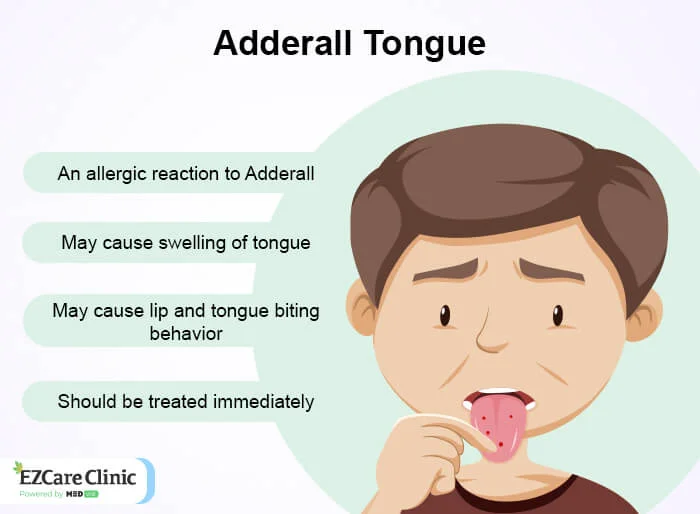
“Adderall tongue” is not a medical diagnosis — it is a colloquial term that has emerged in patient communities to describe the cluster of oral side effects that Adderall and other stimulant ADHD medications cause. These include dry mouth, tongue soreness and swelling, mouth ulcers or sores, a bitter or metallic taste, bad breath, and tongue discolouration.
For patients newly started on Adderall, understanding what is causing these symptoms, how long they are likely to last, and what can be done about them is essential — both for managing comfort and for protecting long-term oral health. Persistent dry mouth from Adderall is not just uncomfortable: it is a clinically significant risk factor for dental cavities, gum disease, and oral infections if not actively managed.
What Is Adderall Tongue?
“Adderall tongue” refers to a cluster of oral side effects that can affect the mouth, tongue, and saliva while taking Adderall:
Symptoms That Make Up Adderall Tongue
- Dry mouth (xerostomia) — reduced saliva production, leading to a persistently dry, parched feeling in the mouth and on the tongue
- Sticky or thick saliva — saliva becomes less fluid and more viscous, coating the tongue and making speech and swallowing uncomfortable
- Tongue soreness — the tongue may feel raw, tender, or inflamed, particularly at the tip and sides
- Mouth ulcers or sores (aphthous ulcers) — painful shallow sores on the tongue, inner cheeks, or gums caused by dry mucosal surfaces, friction from teeth, or reduced immune protection from saliva
- Tongue swelling — mild inflammation of the tongue or inner cheeks in some patients
- Bitter, metallic, or bad taste — altered taste perception and halitosis caused by reduced salivary flow and bacterial overgrowth
- Tongue discolouration — white or yellow coating on the tongue from dry-mouth-related bacterial changes
- Bruxism (teeth clenching) — Adderall’s stimulant effects can cause unconscious jaw clenching that damages the tongue, cheeks, and teeth
- Lip dryness and cracking — extension of the dry mouth effect to the lips
- Heightened thirst — the body’s signalling response to dehydration and reduced salivary output
Not every patient experiences all of these symptoms. The most universal and consistent is dry mouth — present to some degree in virtually all Adderall users.
Why Does Adderall Cause These Symptoms? The Mechanism
Adderall produces oral side effects through two distinct but related pharmacological pathways:
Pathway 1 — Sympathomimetic Suppression of Saliva
Adderall is a sympathomimetic — it activates the sympathetic (fight-or-flight) nervous system by increasing norepinephrine and dopamine signalling:
- Salivary glands are controlled by the parasympathetic (rest-and-digest) nervous system — stimulation of the parasympathetic nerves drives saliva production
- When Adderall activates the sympathetic system, it simultaneously suppresses the parasympathetic signals that normally drive saliva flow
- The result is reduced salivary gland output — less saliva is produced, particularly during the hours when Adderall is most active (the 4–12 hour therapeutic window)
- This suppression acts both peripherally at the salivary glands themselves and centrally at the salivatory nuclei in the brainstem
Pathway 2 — Vasoconstriction and Dehydration
Adderall also causes vasoconstriction — narrowing of blood vessels throughout the body:
- Blood vessels in the gums and oral tissues constrict, reducing blood flow to the salivary glands and further reducing saliva production
- Simultaneously, Adderall increases sweating and suppresses the sensation of thirst while the medication is active — leading to mild systemic dehydration that compounds the oral dryness
- The “fight-or-flight” state that Adderall mimics is physiologically designed to divert resources away from digestion and saliva production — the body acts as though it is in acute stress
Why Dry Mouth Leads to Sores, Ulcers, and Infections
Saliva is not merely lubricant — it has critical protective and antibacterial functions in the oral environment:
- Antibacterial: Saliva contains immunoglobulins, lysozyme, and lactoferrin that suppress bacterial and fungal growth
- Buffering: Saliva neutralises the acidic by-products of bacterial metabolism that erode tooth enamel
- Mechanical cleansing: Salivary flow washes food particles and bacteria off teeth, gums, and tongue
- Mucosal protection: Saliva lubricates the mucosa, preventing friction injuries from normal tongue and cheek movement against teeth
When saliva is chronically reduced by Adderall, all of these protective functions are diminished simultaneously:
- Bacteria multiply more rapidly → bad breath, infection risk
- Acid is not neutralised → cavity risk increases dramatically
- Mucosal friction increases → tongue sores from rubbing against teeth
- Immune protection weakens → aphthous ulcers and oral thrush risk increase
How Long Does Adderall Tongue Last? The Full Timeline
The Adjustment Period (First 2–4 Weeks)
For many patients — particularly those starting at lower doses — Adderall tongue symptoms are most noticeable in the first 1–4 weeks of treatment and improve as the body adjusts:
- The body’s initial response to sympathomimetic stimulation is strongest in the early weeks before neurological and physiological adaptation occurs
- Dry mouth, altered taste, and tongue discomfort often improve significantly or resolve partially by weeks 2–4
- Some community members report the side effect “went away relatively quickly — maybe a week or two”
- Another patient noted: “For me, it lasted a few weeks but I hardly notice it anymore”
If Symptoms Persist Beyond 4 Weeks
If Adderall tongue has not meaningfully improved by weeks 4–6, it is likely to persist as a chronic side effect for the duration of treatment:
- Adderall XR, which maintains therapeutic drug levels throughout the day, produces more persistent dry mouth than IR (which wears off in 4–6 hours, allowing some salivary recovery in the off-window)
- Higher doses produce more severe and persistent oral dryness
- Some patients report dry mouth persisting for the entire 2+ years of their treatment without significant improvement
- For these patients, the management strategy shifts from “wait for it to pass” to active, ongoing oral care
Mouth Sores and Ulcers: Individual Healing Timeline
Adderall-associated mouth ulcers (aphthous ulcers) behave similarly to canker sores triggered by other causes:
- Individual ulcers typically heal within 7–14 days with adequate oral hygiene and hydration
- The NHS clinical guideline for mouth ulcers states: “Mouth ulcers should clear up on their own within a week or 2” — see a doctor if an ulcer persists beyond 3 weeks
- The Cleveland Clinic’s guidance on mouth ulcer treatment confirms the same 1–2 week healing timeline for standard aphthous ulcers
- Recurrence is the central clinical problem — if Adderall is continued without preventive management, new ulcers form on the same cycle, meaning patients experience almost continuous ulceration rather than episodic healing
- One patient found that taking one Adderall-free day per week prevented the ulcers from reaching their most severe level
When Adderall Tongue Resolves Completely
Adderall tongue resolves fully when:
- The medication is stopped — saliva production returns to normal within days of stopping, and most oral symptoms resolve within 1–2 weeks of discontinuation
- Dose is significantly reduced — lower doses suppress parasympathetic salivary function less severely; some patients find symptoms resolve when titrated down
- The body fully adapts (for the minority of patients who experience full resolution on the same dose) — complete adaptation is seen in some patients within 4–6 weeks
How Long Does Adderall Tongue Last: Summary
| Symptom | Typical Duration |
|---|---|
| Initial dry mouth (starting medication) | 1–4 weeks, often improving with adaptation |
| Persistent dry mouth (same dose, higher dose) | Ongoing for duration of treatment in many patients |
| Individual mouth ulcer/sore | 7–14 days per ulcer episode |
| Recurring ulcers (without prevention) | Cyclical/continuous while Adderall is taken |
| Bad taste, tongue discolouration | Tied to dry mouth duration — improves with hydration |
| Tongue soreness | Varies: days to weeks; recurs if ulcers persist |
| Full resolution after stopping Adderall | Days to 2 weeks after last dose |
Factors That Determine How Long Adderall Tongue Lasts For You
Dose
Higher doses produce more severe and persistent oral dryness:
- Patients who experience significant worsening of symptoms after a dose increase (as in the Reddit thread where a patient went from 10 mg to 20 mg XR) commonly report that symptoms are “much worse” at the higher dose and may not fully adapt
- Dose reduction is one of the most effective clinical strategies for managing persistent Adderall tongue
Formulation: IR vs. XR
Adderall XR produces more sustained salivary suppression than IR because it maintains therapeutic levels for 10–12 hours vs. IR’s 4–6 hours:
- With IR, the off-dose window (especially overnight) allows partial saliva recovery
- With XR, dry mouth persists across virtually the entire waking day
- Patients transitioning from IR to XR commonly report their dry mouth becoming “much worse” because there is no longer a rest period
Individual Sensitivity
Some patients are highly sensitive to the sympathomimetic effect on salivary glands; others experience minimal oral dryness at the same dose:
- Genetic and physiological differences in autonomic nervous system tone affect how strongly Adderall suppresses parasympathetic salivary drive
- Patients with pre-existing dry mouth conditions (Sjogren’s syndrome, other autoimmune disorders) will experience more severe Adderall tongue
Oral Hygiene and Preventive Practices
Patients who actively manage oral hygiene, hydration, and salivary support experience shorter and less severe episodes:
- Active management does not cure Adderall tongue but prevents it from escalating to severe ulceration and oral infection
- Without proactive management, cumulative oral damage from chronic dry mouth worsens over time
Pre-existing Oral Health
Patients with pre-existing gum disease, frequent canker sores, or prior dental problems are more susceptible to severe Adderall tongue:
- Reduced salivary protection in an already compromised oral environment accelerates disease progression
- These patients should inform their dentist they are taking Adderall before any oral health evaluation
How to Get Rid of Adderall Tongue: Evidence-Based Remedies
First-Line: Hydration
The most important and universally recommended intervention:
- Drink water consistently throughout the day — not just when thirsty (thirst sensation is suppressed by Adderall)
- A community consensus recommendation is to carry a water bottle at all times and drink throughout the day
- Electrolyte supplementation: Several community members and one pharmacist commentator note that stimulants cause electrolyte loss — plain water alone can worsen electrolyte imbalance by further diluting sodium and potassium. Electrolyte supplements (LMNT, Liquid IV) or electrolyte-containing drinks help maintain salivary function more effectively than water alone
Second-Line: Salivary Substitutes and Stimulants
Clinical guidance from Dr. Oracle and dental practice guidelines recommends sugar-free salivary stimulants as first-line pharmacological therapy before prescription options:
- Biotene products (mouthwash, gel, spray): Specifically formulated for dry mouth; contain enzymes that mimic saliva’s antibacterial properties; universally recommended by dentists for Adderall users
- Sugar-free gum and lozenges (xylitol-based): Chewing stimulates salivary gland output mechanically; xylitol actively inhibits the bacteria that thrive in dry-mouth environments
- ACT dry mouth lozenges: Specifically recommended by dental professionals for Adderall-associated dry mouth
- Oral Balance gel and other dry mouth gels: Applied directly to the tongue and inner cheeks to coat and protect the mucosa during high-dry-mouth periods
Third-Line: Prescription Sialogogues
For severe, refractory dry mouth that does not respond to hydration and OTC products:
- Pilocarpine (Salagen): A muscarinic agonist that directly stimulates salivary gland secretion — counteracts Adderall’s parasympathetic suppression at a receptor level
- Cevimeline (Evoxac): Similar mechanism to pilocarpine — stimulates M3 muscarinic receptors on salivary glands
- These require a prescription; discuss with your prescriber if OTC approaches are insufficient
Mouth Sore Management
For aphthous ulcers and tongue sores specifically:
- Salt water rinse: ½ teaspoon salt in warm water, swished and spat; reduces bacterial load and promotes healing
- Hydrogen peroxide and water (1:1 ratio): Antiseptic rinse; reduces infection risk; several community members report this accelerates healing
- Closys mouthwash: Dentist-recommended antiseptic mouthwash
- Orajel benzocaine gel: Over-the-counter topical anaesthetic for pain relief on individual ulcers
- Triamcinolone in Orabase: Prescription topical corticosteroid paste for severe, persistent ulcers; applied directly to the sore
- Dental wax: Applied over sharp tooth edges that the tongue rubs against — prevents friction injury
- Vitamin B complex: Deficiency in B vitamins (B12, folate, B6) is associated with aphthous ulcers; supplementation may reduce frequency in susceptible individuals
Preventive Dental Care
Long-term Adderall use without active dental management carries serious oral health consequences:
- Inform your dentist that you take Adderall — this changes the clinical focus of your dental care to cavity prevention and dry mouth management
- Prescription fluoride toothpaste (Prevident 5000): Dental professionals recommend high-fluoride toothpaste for stimulant medication users at elevated cavity risk — applied before bed, worn overnight
- Increase dental check-up frequency to every 4–6 months (rather than standard 12-month schedule) to catch early decay before it progresses
- Avoid sugary foods and drinks during Adderall’s active window — the combination of reduced saliva (less acid buffering) and sugar is the primary driver of rapid cavity development in Adderall users
- Night guard: If bruxism (teeth clenching) is occurring while on Adderall, a dental night guard prevents teeth damage and reduces tongue and cheek injuries from clenching
When to See a Doctor or Dentist About Adderall Tongue
Most Adderall tongue symptoms are manageable with the above interventions — but certain signs warrant prompt professional assessment:
See a dentist promptly if:
- A mouth ulcer persists beyond 3 weeks without healing
- You notice new or rapidly developing cavities or tooth decay
- You have signs of oral thrush — white patches on the tongue or inner cheeks that cannot be wiped away
- Gum bleeding that is increasing or not improving
- Persistent swelling, severe pain, or ulcers that bleed without provocation
Speak to your prescriber if:
- Adderall tongue is significantly affecting quality of life, eating, or speech
- Symptoms have not improved at all after 4–6 weeks on the same dose
- You are considering stopping Adderall because of oral side effects — a dose reduction, formulation change, or medication holiday schedule may resolve the problem without discontinuing treatment entirely
- Mouth sores are recurring every dosing cycle without any break period
FAQ — How Long Does Adderall Tongue Last?
How long does Adderall tongue last?Adderall tongue typically improves within 2–4 weeks for patients whose bodies adapt to the medication — but persists as an ongoing side effect for others for the full duration of treatment. Whether it resolves depends on dose, formulation, individual sensitivity, and how actively it is managed.
Does Adderall dry mouth go away?For many patients, yes — it improves significantly within the first month. For others, particularly on higher doses or XR, it persists chronically. It fully resolves within days to 2 weeks of stopping Adderall.
How long do Adderall mouth sores last?Individual mouth ulcers caused by Adderall typically heal within 7–14 days. However, without preventive management (hydration, oral hygiene, salivary support), new sores form continuously — making it feel like they never fully clear.
Why does Adderall make my tongue feel weird?Adderall activates the sympathetic nervous system, which suppresses the parasympathetic signals that drive saliva production. The result is dry mouth, altered taste, sticky saliva, and reduced mucosal protection — all of which cause the tongue to feel sore, coated, dry, or burnt.
Does higher dose Adderall cause worse tongue symptoms?Yes — higher doses produce more pronounced sympathomimetic effects and more severe salivary suppression. Patients who notice significant worsening after a dose increase often find that the side effect is dose-dependent and may improve with a reduction.
Is Adderall tongue dangerous?Adderall tongue itself is not medically dangerous in the short term — it is uncomfortable but manageable. The long-term risk is cumulative oral health damage: chronic dry mouth dramatically increases cavity risk, gum disease, and infection susceptibility. Without proactive dental management, this can lead to significant dental deterioration over months to years of treatment.
What is the best remedy for Adderall tongue?The most evidence-supported interventions are: consistent hydration with water and electrolytes throughout the day, sugar-free xylitol gum or lozenges, Biotene dry mouth products, and informing your dentist of your Adderall use for prescription fluoride and closer monitoring. For severe cases, prescription pilocarpine or cevimeline directly stimulates saliva production.
The Bottom Line
Adderall tongue lasts a few weeks for some patients and indefinitely for others — the variable is how well the individual’s body adapts to sustained sympathomimetic suppression of saliva. The dry mouth component is present in virtually every Adderall user to some degree; the mouth ulcers and sores are less universal but highly disruptive when they occur, healing individually in 7–14 days but recurring constantly without preventive management. The oral health consequences of unmanaged Adderall tongue are real and cumulative — chronic dry mouth is a leading cause of cavities and gum disease in long-term Adderall users. Proactive management (hydration, electrolytes, Biotene, xylitol products, and increased dental care) addresses the symptoms effectively; a conversation with your prescriber about dose adjustment resolves the root cause if symptoms are severe.
How long does adderall tongue last Hobart
How long does adderall tongue last Devonport
How long does adderall tongue last Launceston
How long does adderall tongue last Tasmania
How long does adderall tongue last Victoria
How long does adderall tongue last Queensland
How long does adderall tongue last Canberra
How long does adderall tongue last Australian Capital Territory
How long does adderall tongue last South Australia
How long does adderall tongue last New South Wales
How long does adderall tongue last Darwin
How long does adderall tongue last Ghan
How long does adderall tongue last Northern Territory
How long does adderall tongue last Australia
How long does adderall tongue last Austria
How long does adderall tongue last Germany
How long does adderall tongue last United Kingdom
How long does adderall tongue last Sweden
How long does adderall tongue last Denmark
How long does adderall tongue last Norway
How long does adderall tongue last Finland
How long does adderall tongue last Iceland
How long does adderall tongue last Netherlands
How long does adderall tongue last Spain
How long does adderall tongue last Ireland
How long does adderall tongue last Switzerland
