
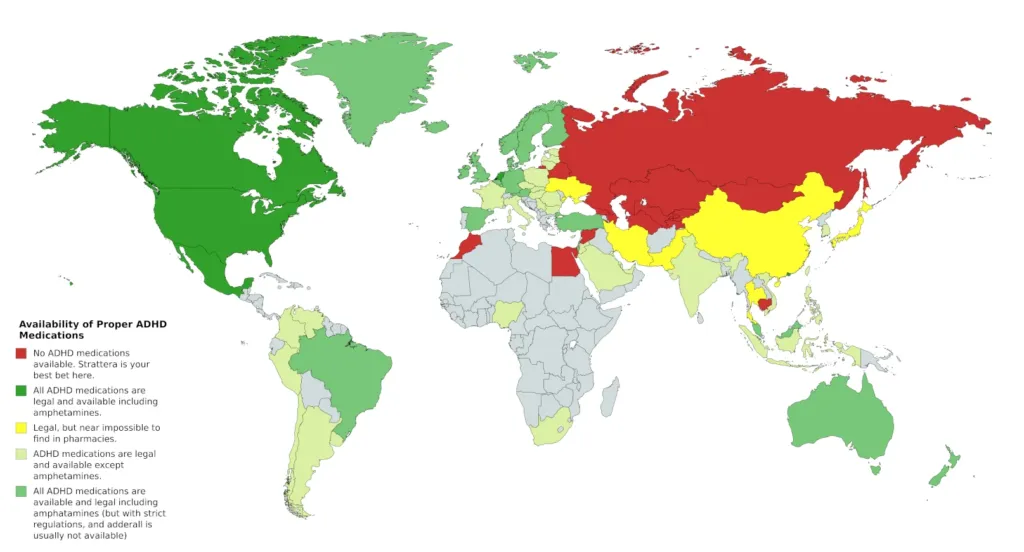
Why is adderall banned in australia? Adderall is not technically “banned” in Australia — the more accurate answer is that it was never submitted for TGA registration by its manufacturer, so it has never been assessed, approved, or made available. The TGA cannot approve a medicine no one has applied to register. The real reason Adderall is absent from the Australian market is a pharmacoeconomic one: with dexamphetamine already established as a PBS-listed option delivering the same active compound, there was and remains no compelling commercial reason for the manufacturer to seek Australian registration. The absence is a business decision, not a safety determination.
Introduction
“Why is Adderall banned in Australia?” is a question loaded with a common misconception embedded in its framing — that Adderall was reviewed, evaluated, and then prohibited by Australian authorities. The reality is more mundane and more instructive: Adderall was never submitted for evaluation. You cannot ban something that was never presented for assessment.
Understanding why Adderall is absent from Australia requires understanding how the Australian drug registration system works, why pharmaceutical companies do and do not apply for registration in different markets, what the competitive landscape for ADHD medications looked like when Adderall might have been a candidate for Australian submission, and why the TGA cannot act unilaterally to make foreign medications available.
This guide addresses all of those questions — and corrects the “ban” framing definitively.
The Precise Legal Reality: Not Banned — Never Registered
The single most important correction this article can make is this: Adderall is not banned in Australia.
“Banned” implies that it was evaluated and prohibited — that the TGA or another authority reviewed it and determined it should not be permitted. This did not happen.
The actual legal situation is simpler: under the Therapeutic Goods Act 1989, any medicine supplied in Australia must first be included on the Australian Register of Therapeutic Goods (ARTG). Inclusion on the ARTG requires a sponsoring company to submit a registration application to the TGA — the TGA does not proactively identify foreign medicines and register them.
Adderall’s manufacturer has never submitted a registration application to the TGA. Without an application, there is nothing to evaluate, approve, or reject. The TGA has confirmed it cannot compel a manufacturer to make such an application. Adderall is therefore not registered — which means it cannot be prescribed, dispensed, imported for personal use through standard channels, or sold in Australia.
The legal consequence of non-registration is that any attempt to supply or import Adderall falls under controlled drug importation law — but this is not because Adderall was declared illegal; it is the default legal position for any unregistered controlled substance. The “ban” framing conflates this downstream consequence with a proactive policy decision that was never made.
How Australian Drug Registration Actually Works
To fully understand why Adderall is absent, understanding the TGA registration process is essential:
Step 1 — Manufacturer/Sponsor InitiativeA pharmaceutical company (the “sponsor”) decides, based on commercial and clinical factors, whether to seek registration of a product in a given market. This is entirely the sponsor’s decision. The TGA plays no role in initiating this process.
Step 2 — Application SubmissionThe sponsor submits a comprehensive application including quality, safety, and efficacy data; completed regulatory forms; and payment of registration fees. For a prescription medicine, this means a full clinical dossier demonstrating the medicine is safe and effective for its intended use.
Step 3 — TGA EvaluationThe TGA evaluates the submission — reviewing clinical trial data, manufacturing quality, safety profiles, and proposed prescribing information. This process typically takes 12–15 months for standard applications.
Step 4 — ARTG Inclusion or RejectionIf the TGA approves the submission, the medicine is included on the ARTG and can be legally prescribed and dispensed in Australia. If it is rejected, the sponsor can appeal or resubmit.
For Adderall: Step 1 never happened. No sponsor has submitted an application for Adderall’s registration in Australia. Consequently, Steps 2–4 have never occurred. There is no TGA file on Adderall, no evaluation report, and no rejection — because there is no application.
The Real Reason: Pharmacoeconomics, Not Safety
The question “why was Adderall never submitted for TGA registration?” has a clear, evidence-supported answer rooted in commercial pharmaceutical economics:
1. Dexamphetamine Was Already Established
When Adderall was developed and patented in the United States in the 1990s, dexamphetamine (pure dextroamphetamine) had already been registered and available in Australia since 1991. It was PBS-listed and widely prescribed by Australian specialists.
From the manufacturer’s perspective, seeking Australian registration for Adderall — a mixed amphetamine salt containing 75% dextroamphetamine and 25% levoamphetamine — against a market already served by pure dextroamphetamine posed a fundamental commercial challenge. The TGA would rightly ask: what clinical advantage does the mixed-salt formulation provide over pure dextroamphetamine that is not already available?
2. The Clinical Differentiation Is Minimal
The pharmacological difference between Adderall (75% d-amphetamine / 25% l-amphetamine) and dexamphetamine (100% d-amphetamine) is real but modest. As noted in detailed community pharmacology discussion by clinician-informed commentators: “Adderall comprises about 75% dextroamphetamine salts, making it nearly identical to pure dextroamphetamine”. The levoamphetamine component extends duration slightly and smooths the concentration curve — but these are incremental, not transformative, clinical differences.
For a TGA registration dossier to succeed, the sponsor would need to demonstrate clinical value. With dexamphetamine already approved and serving the same core therapeutic need, building a compelling differentiating clinical argument would have been difficult.
3. Vyvanse Further Closed the Gap
When Vyvanse (lisdexamfetamine) was approved in Australia in 2015, the case for Adderall registration became even weaker commercially. Vyvanse — also manufactured by the same company that makes Adderall (Shire, now Takeda) — provides once-daily extended coverage with a smoother profile and lower abuse potential, addressing precisely the clinical gaps that Adderall XR was designed to fill. Having successfully registered Vyvanse in Australia, there was no remaining product gap for Adderall to fill from the manufacturer’s perspective.
4. The US Marketing Dynamic Did Not Apply in Australia
In the United States, Adderall’s dominance in the ADHD medication market was substantially shaped by Shire’s aggressive marketing strategy following its patent acquisition in the late 1990s. The US market was flooded with Adderall through physician marketing, DTC advertising, and pharmacy incentive programs in a way that the Australian market — with its tighter therapeutic goods advertising regulations and different prescribing culture — would not have supported.
The Australian drug reimbursement environment is also different: PBS listing, which determines whether a medication is affordable for Australian patients, requires a separate PBAC (Pharmaceutical Benefits Advisory Committee) application and health technology assessment. This adds another layer of time, cost, and commercial risk that further reduces the attractiveness of registering a medication facing stiff competition from already-PBS-listed equivalents.
5. Registration Costs vs. Commercial Return
TGA registration of a new prescription medicine involves significant upfront investment — application fees, the cost of preparing a clinical dossier, ongoing pharmacovigilance obligations, and post-market requirements. Sponsors make commercially rational decisions about where to invest these resources based on expected market return. With an established generic dextroamphetamine already capturing the relevant patient segment, and Vyvanse occupying the premium extended-release market, the expected commercial return from Adderall registration in Australia was insufficient to justify the investment.
The “Ban” Framing: Why It Persists and Why It Matters
The framing of Adderall as “banned” in Australia persists for several understandable reasons:
- The functional outcome resembles a ban — you cannot get Adderall in Australia regardless of the reason, so “banned” feels descriptively accurate even if technically incorrect
- The term “banned” appears in reputable-looking online content — including, misleadingly, some pharmaceutical summary sites that list Australia as a country where Adderall is “banned” alongside countries that have made active prohibition decisions
- People importing Adderall face legal consequences — which reinforces the perception that it is prohibited, even though the legal risk arises from unregistered-substance importation law rather than a specific Adderall ban
- The distinction between “banned” and “never registered” is not intuitive for people unfamiliar with how pharmaceutical regulation works
Why does the distinction matter? Because the “ban” framing implies a safety determination was made — that Australian authorities reviewed the evidence and concluded Adderall was too dangerous. This is false, and it is potentially harmful: it discourages Australians from advocating for medication diversity, creates unnecessary stigma around the drug’s pharmacological family (dextroamphetamine is fully legal), and generates conspiracy-adjacent narratives about the TGA’s motivations.
The accurate framing — “Adderall was never submitted for TGA registration because there was insufficient commercial reason to do so” — is less emotionally compelling but more clinically and factually correct.
Could Adderall Be Registered in Australia in the Future?
Theoretically, yes — a pharmaceutical sponsor could apply for Adderall’s TGA registration at any time. The TGA would evaluate the application through its standard process. If the clinical and quality data were satisfactory, registration could be granted.
In practice, the commercial and regulatory hurdles remain the same as they always have been — arguably more so, given that:
- Generic dexamphetamine (Aspen Dexamfetamine) is PBS-listed and inexpensive
- Vyvanse is PBS-listed and captures the premium extended-release market
- Adderall’s US patent has long expired, meaning the original manufacturer has even less commercial incentive to pursue new markets for the brand formulation
- A generic manufacturer seeking to register a mixed amphetamine salt product in Australia would face the same differentiation challenges
Some Australian ADHD advocates and patients have formally petitioned for the availability of mixed amphetamine salt formulations — the TGA’s Freedom of Information records include patient submissions specifically requesting Adderall and Desoxyn availability. The TGA’s response has been consistent: it cannot compel sponsors to make registration applications, and the SAS pathway exists for individual patients with documented unmet clinical need.
What Australians Get Instead — And Why It Is Clinically Sufficient
The absence of Adderall in Australia represents an unmet brand preference, not an unmet clinical need:
Aspen Dexamfetamine (dexamphetamine sulfate 5 mg IR tablets) delivers pure dextroamphetamine — the same primary active compound as Adderall, without levoamphetamine — PBS-listed since 1991. Per milligram, it is actually more potent than Adderall because there is no less-potent l-isomer diluting the dose.
Vyvanse (lisdexamfetamine 20–70 mg capsules) converts entirely to dextroamphetamine in the body — delivering the same active molecule as dexamphetamine via a smooth, extended, once-daily prodrug mechanism — PBS-listed and arguably clinically superior to Adderall XR for most adults in terms of tolerability and coverage consistency.
For a patient who took Adderall in another country and arrives in Australia: the active compound they need (dextroamphetamine) is fully available, regulated, affordable, and prescribed by specialists across the country. The brand name is different; the therapeutic outcome is clinically equivalent.
Common Misconceptions
Myth 1: “The TGA decided Adderall was too dangerous and banned it.”The TGA has never evaluated Adderall — there is no application on file, no review was conducted, and no safety determination was made. The TGA can only evaluate medicines that sponsors submit for assessment. No sponsor has submitted Adderall for Australian registration.
Myth 2: “Adderall is banned because Australia has stricter drug laws than the US.”Australia’s amphetamine-class ADHD medications are regulated as Schedule 8 controlled substances — the same general category as Adderall’s Schedule II classification in the US. The regulatory framework is comparable in stringency. The absence of Adderall is commercial, not regulatory.
Myth 3: “Adderall was banned because it’s more addictive than Australian alternatives.”There is no documented TGA determination on Adderall’s addictiveness relative to available alternatives — because no such determination was ever made. The claim that Adderall is “more addictive” than dexamphetamine is, if anything, backwards pharmacologically: pure dextroamphetamine is marginally more potent per milligram, and levoamphetamine may actually produce some moderating effects on the concentration curve. No credible regulatory source supports the “Adderall was banned for being too addictive” narrative.
Myth 4: “If the TGA wanted to, they could make Adderall available.”The TGA’s own official responses confirm it cannot compel manufacturers to submit registration applications. The TGA is a reactive regulatory body — it evaluates what sponsors submit. It does not proactively source or approve medicines. The SAS pathway allows individual case-by-case access, but this is not equivalent to full market registration.
Myth 5: “Adderall would work better than Australian alternatives for ADHD.”There is no clinical evidence supporting this claim. Meta-analyses comparing amphetamine formulations for ADHD do not show Adderall outperforming pure dextroamphetamine or Vyvanse. The active therapeutic compound — dextroamphetamine — is the same. Individual response variation exists within all formulations, but the argument that Adderall specifically would be superior to the available Australian options is not supported by clinical evidence.
FAQ — Why Is Adderall Banned in Australia?
Why is Adderall banned in Australia?Adderall is not technically banned — it was never submitted for TGA registration. The TGA can only approve medicines that sponsors apply to register; no company has applied for Adderall’s registration in Australia. Its absence is a commercial decision by the manufacturer, not a safety prohibition by Australian regulators.
Did the TGA ban Adderall?No — the TGA has never reviewed, evaluated, or prohibited Adderall. There is no TGA decision on Adderall because there was never an application. The TGA has confirmed in official responses that it cannot compel sponsors to submit registration applications.
Why didn’t the manufacturer apply for TGA approval of Adderall in Australia?The primary reason is commercial: dexamphetamine (pure dextroamphetamine) was already PBS-listed and available in Australia when Adderall was developed, providing the same active compound. Vyvanse (lisdexamfetamine — also manufactured by Adderall’s maker, Takeda) was subsequently registered in Australia in 2015, filling the extended-release market. With both ends of the market served by existing products delivering dextroamphetamine, there was insufficient commercial incentive to seek registration for the mixed-salt Adderall formulation.
Is there any pathway to access Adderall in Australia?Two narrow pathways exist: the traveller’s exemption (up to a 3-month supply in accompanied baggage for visitors, with prescription documentation) and the Special Access Scheme (case-by-case TGA approval for individual patients with documented unmet clinical need). Neither provides ongoing access for Australian residents — once a traveller’s supply runs out, no legal refill pathway exists.
Could Adderall ever be registered in Australia?Theoretically, yes — a sponsor could submit a TGA registration application at any time. In practice, the commercial hurdles remain the same: generic dexamphetamine and PBS-listed Vyvanse cover the clinical ground, patent expiry removes the commercial incentive for the original manufacturer, and generic sponsors would face the same differentiation challenge. There is no current indication that any company is pursuing TGA registration for mixed amphetamine salts in Australia.
What can Australians take instead of Adderall?Aspen Dexamfetamine (pure dextroamphetamine IR, equivalent to Adderall IR) and Vyvanse(lisdexamfetamine prodrug → dextroamphetamine, equivalent to Adderall XR) are both TGA-approved, PBS-listed, and deliver the same active compound. Both are accessible through specialist prescription.
Is Adderall illegal in Australia?Possessing, importing, or distributing Adderall without TGA authorisation is illegal under Australian law — but this is a consequence of it being an unregistered controlled substance, not a specific targeted prohibition. The same legal status would apply to any unregistered Schedule 8 substance. Importing it without a permit carries criminal penalties under the Commonwealth Criminal Code.
The Bottom Line
Adderall is absent from Australia not because it was reviewed and found too dangerous, but because no pharmaceutical sponsor has ever submitted it for TGA registration — a commercial decision driven by the pre-existence of dexamphetamine and, later, Vyvanse in the Australian market. The TGA cannot register medicines that no one applies to register. The “ban” framing, while understandable given the functional outcome, is factually incorrect and carries misleading implications about a safety determination that was never made. For Australian patients, the clinical reality is that the active compound in Adderall — dextroamphetamine — is fully available through PBS-listed medications, prescribed by specialists, and covered at affordable prices. The brand name is absent; the medicine is not.
Why is Adderall banned in Australia Hobart
Why is Adderall banned in Australia Devonport
Why is Adderall banned in Australia Launceston
Why is Adderall banned in Australia Tasmania
Why is Adderall banned in Australia Victoria
Why is Adderall banned in Australia Queensland
Why is Adderall banned in Australia Canberra
Why is Adderall banned in Australia Australian Capital Territory
Why is Adderall banned in Australia South Australia
Why is Adderall banned in Australia New South Wales
Why is Adderall banned in Australia Darwin
Why is Adderall banned in Australia Ghan
Why is Adderall banned in Australia Northern Territory
Why is Adderall banned in Australia Australia
Why is Adderall banned in Australia Austria
Why is Adderall banned in Australia Germany
Why is Adderall banned in Australia United Kingdom
Why is Adderall banned in Australia Sweden
Why is Adderall banned in Australia Denmark
Why is Adderall banned in Australia Norway
Why is Adderall banned in Australia Finland
Why is Adderall banned in Australia Iceland
Why is Adderall banned in Australia Netherlands
Why is Adderall banned in Australia Spain
Why is Adderall banned in Australia Ireland
Why is Adderall banned in Australia Switzerland
