
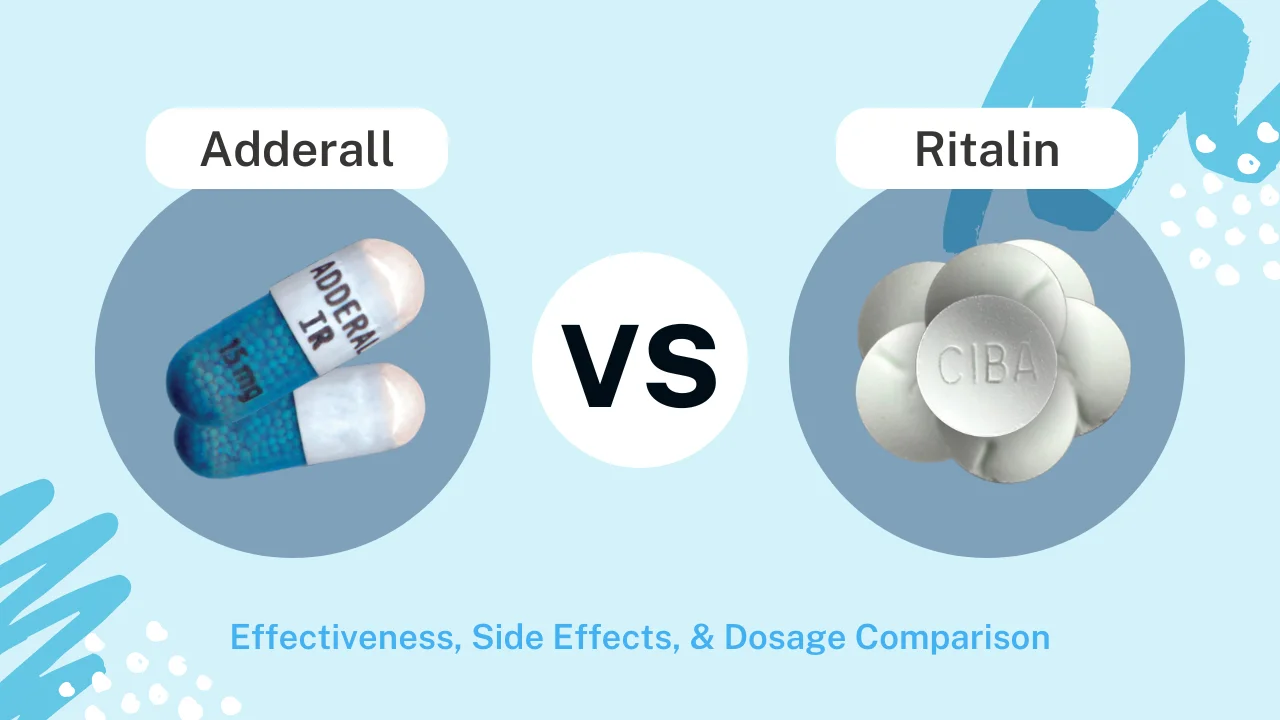
Is adderall the same as ritalin? No — Adderall and Ritalin are not the same. They are both stimulant medications prescribed for ADHD and both target dopamine and norepinephrine, but their active ingredients, mechanisms of action, duration, potency, and side effect profiles are meaningfully different. Adderall contains amphetamine salts; Ritalin contains methylphenidate. Understanding the specific differences between them is directly relevant to which one is more likely to work best for you.
Introduction
Adderall and Ritalin are the two most recognised ADHD medication names in the world — and the most commonly confused. Patients switching between them, parents trying to understand their child’s prescription, and adults newly diagnosed with ADHD all encounter the same question: are these essentially the same drug under different names, or are they genuinely different?
They are genuinely different — at the level of chemistry, mechanism, onset, duration, potency, and side effect profile. The differences matter clinically: research consistently shows that individual patients can respond very differently to each drug, and that the drug that works well for one person may work poorly or produce worse side effects for another. This guide gives you the complete, evidence-based comparison.
What You Need to Know First
Both Adderall and Ritalin are central nervous system stimulants classified as Schedule II controlled substances. Both are FDA-approved for ADHD treatment in children and adults, and for narcolepsy. Both increase the availability of dopamine and norepinephrine in the brain’s prefrontal cortex — the region governing attention, impulse control, and executive function.
Where they diverge is in how they achieve this:
- Ritalin works primarily as a reuptake inhibitor — it blocks the transporters that remove dopamine and norepinephrine from the synapse, keeping existing levels elevated for longer
- Adderall does this and more — it also causes neurons to actively release additional dopamine and norepinephrine, and inhibits autoreceptors that would otherwise slow neurotransmitter production
This dual mechanism is why Adderall is generally considered more potent at equivalent doses — it both blocks removal and boosts supply, while Ritalin only blocks removal.
Head-to-Head: Adderall vs. Ritalin
The Mechanism Difference — Why It Matters
The distinction between “blocking reuptake” (Ritalin) and “blocking reuptake and increasing release” (Adderall) is not merely academic — it translates directly into felt experience.
Adderall’s release mechanism means dopamine is pushed into the synapse from inside the neuron as well as being prevented from leaving. The net effect is a larger, faster dopamine surge — which is why patients often describe Adderall as feeling “stronger” or more noticeable when it kicks in. It also partially explains Adderall’s slightly higher addiction potential: the faster and larger dopamine spike is more reinforcing neurologically.
Ritalin’s reuptake-only mechanism produces a more modulated dopamine effect — preserving what the brain naturally releases rather than artificially increasing the total output. This is thought to contribute to its generally better tolerability and lower anxiety-amplification tendency in clinical practice.
Onset and Duration: The Practical Daily Difference
For day-to-day treatment, the timing differences are among the most clinically significant distinguishing features:
Ritalin acts faster but wears off sooner. IR Ritalin typically reaches peak effects within 1–2 hours of dosing and clears within 3–4 hours — meaning some patients require two or even three doses to cover a full work or school day. The rapid onset can feel more precise: patients know quickly whether the dose is working.
Adderall acts slightly slower but lasts longer. IR Adderall reaches peak effects in about 1–3 hours and remains therapeutic for 4–6 hours — generally allowing a once or twice-daily IR dosing schedule. Adderall XR, providing up to 12 hours of coverage, is widely used for single-daily dosing.
In direct head-to-head research, Adderall was significantly better than low-dose Ritalin at midday and in the late afternoon — the periods when Ritalin’s effects were waning. This temporal advantage is one of the primary reasons Adderall remains widely preferred by adults with demanding full-day schedules.
Which One Works Better? What the Research Shows
The honest answer is that both medications work well for ADHD — with important population-level nuances.
A large meta-analysis published in Lancet Psychiatry — arguably the most comprehensive comparative analysis of ADHD medications — found that amphetamine-based medications (including Adderall) were the preferred choice for adults, while methylphenidate-based medications (including Ritalin) had greater tolerability overall and were preferred in children. The American Academy of Pediatrics clinical guidelines specify methylphenidate as the preferred first-line treatment in children.
Across multiple study designs, Adderall shows a slight edge over Ritalin in reducing ADHD core symptoms at equivalent therapeutic doses — but Ritalin shows a slight edge in tolerability, with fewer patients discontinuing due to side effects. The practical summary: Adderall is somewhat stronger; Ritalin is somewhat better tolerated.
Importantly, individual response predicts clinical outcome more reliably than population averages. Patients who respond poorly to one stimulant class frequently respond well to the other — meaning a trial of the alternative is always clinically justified if the first choice produces inadequate benefit or unacceptable side effects.
Side Effects: Where They Overlap and Where They Differ
Shared side effects (both medications):
- Reduced appetite and potential weight loss
- Insomnia — particularly with late dosing
- Headaches
- Dry mouth
- Increased heart rate and blood pressure
- Nausea
- Anxiety, irritability, and mood changes
- Crash or rebound as medication wears off
Where they differ:
- Adderall is more likely to produce anxiety, significant insomnia, and cardiovascular side effects — a consequence of its larger and faster dopamine release
- Ritalin is more likely to produce stomach upset — methylphenidate has a greater tendency toward gastrointestinal side effects and is more irritating to the gastric lining in some patients
- Adderall’s crash tends to be more pronounced and noticeable given the larger dopamine swing
- Ritalin’s crash is shorter in duration due to its faster clearance, though it may require more frequent dosing to avoid multiple crash windows
- Peripheral vasoconstriction, Raynaud’s phenomenon, and bruxism are documented side effects of both drug classes, though the research base is more extensive for amphetamines
Both medications carry the same FDA black box warning regarding abuse and dependence potential as Schedule II controlled substances.
Children vs. Adults: Does the Choice Differ?
Clinical guidelines and the research evidence converge on a meaningful age-related preference:
For children: Methylphenidate (Ritalin) is the recommended first-line stimulant treatment in most clinical guidelines, including American Academy of Pediatrics guidelines and most international equivalents. It has a longer evidence base in paediatric populations, is more extensively studied in this group, and is generally better tolerated in children.
For adults: Amphetamine-based medications including Adderall show a slight efficacy advantage per the Lancet Psychiatry meta-analysis, and adults are often better able to manage the more pronounced onset and offset of amphetamine effects. That said, methylphenidate remains a highly effective first-line option for adults and is often trialled first in countries where amphetamines face greater prescribing restrictions.
Both medications are approved for use in both age groups, and the preference is a guideline-level population trend rather than an absolute rule — individual response always overrides population averages in clinical decision-making.
Brand Names and Generic Equivalents
Both medications are available under a wide range of brand and generic names:
Adderall equivalents (amphetamine-based):
- Adderall IR, Adderall XR (USA)
- Vyvanse (lisdexamfetamine — prodrug that converts to dextroamphetamine; available in Australia)
- Dexamphetamine / Dexedrine (pure dextroamphetamine; available in Australia)
Ritalin equivalents (methylphenidate-based):
- Ritalin IR, Ritalin LA (Australia: PBS-listed)
- Concerta (methylphenidate ER; available in Australia)
- Methylin, Metadate, Quillivant (USA)
- Focalin / dexmethylphenidate (USA)
The active ingredient is what matters clinically — brand name and generic formulations of the same active ingredient are therapeutically equivalent at the same dose.
Australian Context: What Is and Isn’t Available
This is critically important for Australian readers:
Adderall is not available in Australia — it is not TGA-approved and cannot be legally prescribed. The closest Australian equivalent in the amphetamine class is Vyvanse (lisdexamfetamine), which converts to dextroamphetamine in the body, and dexamphetamine(pure dextroamphetamine) — both available under specialist prescription.
Ritalin is available in Australia on the PBS. Methylphenidate products including Ritalin IR, Ritalin LA, and Concerta are TGA-approved and PBS-listed for ADHD treatment. Supply shortages of some methylphenidate formulations have been documented in recent years, prompting TGA guidance on alternatives.
All ADHD medications in Australia — whether methylphenidate or amphetamine-based — require a specialist (psychiatrist or paediatrician) prescription. The choice between methylphenidate and lisdexamfetamine/dexamphetamine in Australia mirrors the Ritalin vs. Adderall decision clinically, and the same research-based considerations apply.
Common Misconceptions
Myth 1: “Adderall and Ritalin are basically the same drug with different names.”They are categorically different drug classes — one is an amphetamine, the other is not. They share a therapeutic goal (raising dopamine and norepinephrine for ADHD) but achieve it through different chemistry and different mechanisms. Patients frequently respond differently to each, and assuming interchangeability leads to poorly informed treatment decisions.
Myth 2: “Adderall is stronger so it must be better.”Potency does not equal therapeutic superiority — it means higher cognitive and cardiovascular activation per milligram, which comes with a corresponding increase in side effect risk. For patients who are already experiencing anxiety, insomnia, or cardiovascular side effects on stimulant medication, a more potent medication is not a clinical upgrade. For patients requiring stronger or longer-lasting coverage, it may be.
Myth 3: “Ritalin is safer because it’s weaker.”Both medications carry identical Schedule II controlled substance classifications and the same abuse and dependence potential warnings. Both produce comparable cardiovascular effects, both can cause psychiatric side effects at above-therapeutic doses, and both require the same clinical monitoring and prescribing caution.
Myth 4: “One clearly works better than the other.”Neither medication universally outperforms the other — individual response varies so substantially that neither can be predicted to be superior for a given patient before trialling. The mild population-level advantages each shows in different contexts (Adderall in adults, Ritalin in tolerability) are averages across thousands of patients, not predictions for any one individual.
FAQ — Is Adderall the Same as Ritalin?
Is Adderall the same as Ritalin?No — they are different medications with different active ingredients and different mechanisms of action. Adderall contains mixed amphetamine salts (dextroamphetamine and levoamphetamine), while Ritalin contains methylphenidate. Both target dopamine and norepinephrine in the brain to improve ADHD symptoms, but Adderall does so through release and reuptake inhibition while Ritalin works only through reuptake inhibition.
Which is stronger — Adderall or Ritalin?Adderall is more potent milligram-for-milligram: a 5 mg Adderall dose is approximately equivalent to a 10 mg Ritalin dose in therapeutic effect. Adderall also tends to produce a more noticeable onset and slightly stronger overall dopamine effect due to its release mechanism. However, greater potency means proportionally greater stimulant side effects — more potential for anxiety, insomnia, and cardiovascular effects.
Which lasts longer — Adderall or Ritalin?Adderall lasts longer. IR Adderall covers 4–6 hours; IR Ritalin covers 2–4 hours. In extended-release form, both can provide up to 8–12 hours of coverage depending on formulation. Adderall was specifically shown to maintain therapeutic effects better than Ritalin at midday and late afternoon — the times when Ritalin’s effects were tapering.
Which is better for adults — Adderall or Ritalin?A large Lancet Psychiatry meta-analysis found that amphetamine-based medications (including Adderall) were the preferred choice for adults when both efficacy and tolerability were considered. However, methylphenidate is still highly effective for many adults and is often the first medication trialled in countries with greater prescribing restrictions on amphetamines. The clinical decision depends on individual history, co-occurring conditions, and prescriber assessment.
Which is better for children — Adderall or Ritalin?Methylphenidate (Ritalin) is the preferred first-line stimulant in children according to the American Academy of Pediatrics and most international clinical guidelines. It has a longer evidence base in paediatric populations and tends to be better tolerated in children. Adderall is also effective in children and is widely used, but Ritalin remains the guideline-preferred starting point.
Can you switch from Adderall to Ritalin or vice versa?Yes — switching between stimulant classes is a standard clinical practice when one medication is producing inadequate benefit or unacceptable side effects. Because they work through different mechanisms, patients who respond poorly to one class frequently respond well to the other. Any switch should be prescriber-guided, and a dose recalibration is needed given the potency difference (5 mg Adderall ≈ 10 mg Ritalin).
Is Adderall available in Australia? What about Ritalin?Adderall is not available in Australia — it is not TGA-approved. The closest Australian equivalents are Vyvanse (lisdexamfetamine) and dexamphetamine, both of which require specialist prescription. Ritalin is available in Australia on the PBS in IR and LA (long-acting) formulations, as is Concerta (methylphenidate extended-release). Both require specialist prescription.
Do Adderall and Ritalin have the same side effects?They share most common side effects — appetite suppression, insomnia, headaches, elevated heart rate, dry mouth, and potential for anxiety and mood changes. Where they differ: Adderall is somewhat more likely to produce anxiety and significant insomnia due to its larger dopamine release effect; Ritalin is somewhat more likely to cause gastrointestinal upset. Adderall’s crash tends to be more noticeable given the larger dopamine swing; Ritalin’s is shorter but may repeat more frequently due to its shorter duration.
The Bottom Line
Adderall and Ritalin are not the same drug — they are chemically distinct, mechanistically different, and produce meaningfully different clinical profiles in terms of onset, duration, potency, and side effect risk. Adderall (amphetamine) tends to be stronger and longer-lasting with a slight adult efficacy edge, while Ritalin (methylphenidate) acts faster, clears sooner, is generally better tolerated, and is the guideline-preferred first-line choice in children. Neither is universally superior — individual response determines which works better for a specific patient, and a trial of the alternative class is always justified if the first choice underperforms. For Australians, Adderall is not available; the functional comparison in practice is between Vyvanse/dexamphetamine and Ritalin/Concerta, and the same clinical considerations apply through a prescribing specialist.
Is Adderall the same as Ritalin Hobart
Is Adderall the same as Ritalin Devonport
Is Adderall the same as Ritalin Launceston
Is Adderall the same as Ritalin Tasmania
Is Adderall the same as Ritalin Victoria
Is Adderall the same as Ritalin Queensland
Is Adderall the same as Ritalin Canberra
Is Adderall the same as Ritalin Australian Capital Territory
Is Adderall the same as Ritalin South Australia
Is Adderall the same as Ritalin New South Wales
Is Adderall the same as Ritalin Darwin
Is Adderall the same as Ritalin Ghan
Is Adderall the same as Ritalin Northern Territory
Is Adderall the same as Ritalin Australia
Is Adderall the same as Ritalin Austria
Is Adderall the same as Ritalin Germany
Is Adderall the same as Ritalin United Kingdom
Is Adderall the same as Ritalin Sweden
Is Adderall the same as Ritalin Denmark
Is Adderall the same as Ritalin Norway
Is Adderall the same as Ritalin Finland
Is Adderall the same as Ritalin Iceland
Is Adderall the same as Ritalin Netherlands
Is Adderall the same as Ritalin Spain
Is Adderall the same as Ritalin Ireland
Is Adderall the same as Ritalin Switzerland
