Yes — Adderall is addictive, and its addiction potential is formally recognised by its DEA Schedule II classification — the highest control level for a drug with accepted medical uses. However, addiction risk is not uniform across all users: it varies dramatically depending on whether the drug is taken as prescribed for a confirmed ADHD diagnosis, used non-medically, or misused at high doses. The critical distinction most sources fail to draw clearly is between physical dependence (the brain’s predictable physiological adaptation to Adderall — which occurs in most long-term users including prescribed patients) and addiction (a neurological disorder characterised by compulsive drug-seeking despite harm — which does not occur in all dependent users). Among prescribed patients, approximately 9% develop stimulant use disorder; among non-medical college users, misuse rates reach 20–30%. The neuroscience is unambiguous: Adderall produces burst-like dopamine discharge in the reward circuitry — the best-documented biological mechanism of addiction across all substances.
Introduction
“Is Adderall addictive?” is a question that deserves a more nuanced answer than either “yes, it’s as addictive as cocaine” or “no, it’s just medication.” Both framings exist and both miss the complexity of what the evidence actually shows.
The pharmacological reality is that Adderall acts on the same dopaminergic reward pathways as cocaine and other highly addictive stimulants — just through a different mechanism and typically at lower concentrations when taken as prescribed. Whether that pharmacological reality translates into clinical addiction depends on dose, frequency, route of administration, diagnosis status, genetic susceptibility, and co-occurring mental health conditions. This guide provides the complete picture: the neuroscience of why Adderall is addictive at a biological level, the critical clinical distinction between dependence and addiction, the actual statistics on addiction prevalence across different user populations, the signs of Adderall addiction, and the evidence-based treatment options.
The Neuroscience: Why Adderall Is Addictive
Understanding why Adderall is addictive requires understanding how the brain’s reward system works — and how Adderall hijacks it:
The Dopamine Reward Mechanism
Adderall’s addiction potential is rooted in one of the most well-established neurobiological mechanisms in addiction science:
- PubMed’s Dopamine and Addiction review states directly: “Most addictive drugs cause elevations in extracellular levels of the neurotransmitter dopamine” — and Adderall does this powerfully
- Adderall forces the presynaptic neuron to flood the synapse with dopamine and simultaneously blocks dopamine reuptake transporters — causing dopamine to accumulate at far higher concentrations than any natural reward (food, sex, accomplishment) can achieve
- PMC’s Dopamine, Behavior, and Addiction journal: “The ability of addictive drugs to cause burst-like discharges in the dopamine system is the broadly assumed correlate of addiction — the direct evidence for this assumption is linked most strongly to amphetamine“
- StatPearls (NIH) neurobiology of addiction: “As the addiction cycle repeats, the firing patterns of dopamine cells transform from responding to novel rewards to anticipating reward-related stimuli. The individual progressively gets a more significant dopamine release from environmental cues (people, places, things) than the actual substance — leading to motivational urges — this is incentive salience“
How the Brain Adapts: Tolerance and Neuroadaptation
The same mechanism that creates Adderall’s therapeutic effect creates its addiction potential:
- With repeated exposure, the brain downregulates D2 dopamine receptors and reduces its own natural dopamine production — a compensatory adaptation to the abnormal dopamine surplus
- Comeback Care’s clinical overview: “Long-term alterations in dopamine function can alter our reward system and make us dependent on chemical assistance to experience pleasure“
- This explains two parallel phenomena: tolerance (needing more Adderall to achieve the same effect) and anhedonia during abstinence (inability to feel pleasure without the drug)
- Talbott Recovery: “Like many other drugs, the dosage increases over time as the body becomes more used to it. This often leads to abuse and even overdose”
Why Prescribed Patients Have Lower Addiction Rates
The pharmacokinetic context of prescribed use matters:
- Oral administration at therapeutic doses produces a gradual rise in dopamine — not the explosive surge produced by snorting or injecting
- The slower onset means less intense euphoric reinforcement — the neurochemical feature most closely associated with addiction development
- PMC 2008 review cited in the Ann Rev Neurosci: “Physical withdrawal symptoms do not occur following cessation of cocaine or amphetamine use” — meaning Adderall’s withdrawal is primarily psychological, not driven by the same physical suffering that compels opioid continued use
- Talbott Recovery: “Unlike many other prescription drugs, Adderall will not cause an addiction in individuals who truly need it as long as they stick to the prescribed dosages”
Physical Dependence vs. Addiction: The Most Important Distinction
These two terms are used interchangeably in popular media — they are not the same thing, and confusing them leads to both unnecessary fear among prescribed patients and underestimation of risk among misusers:
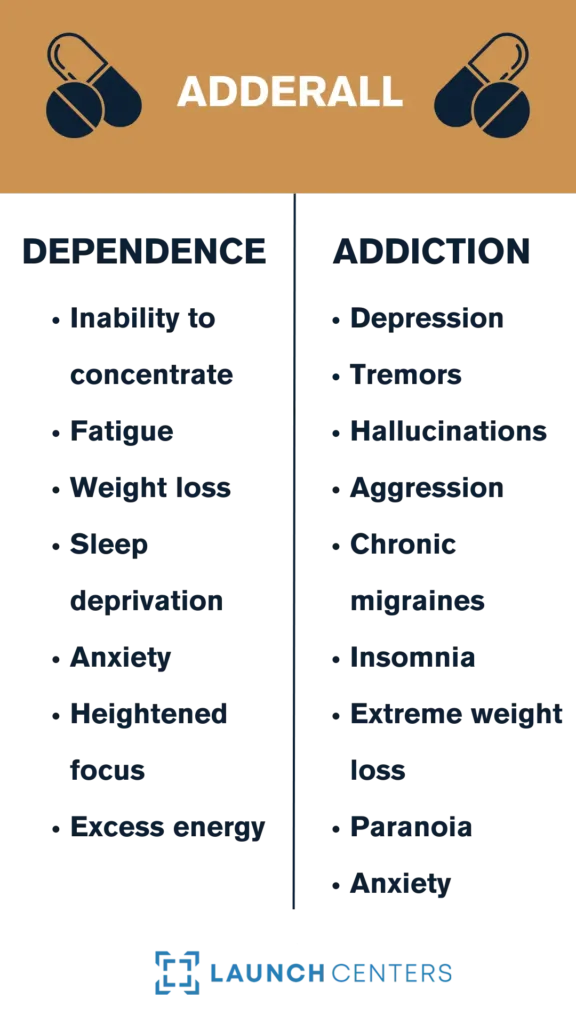
Physical Dependence
Definition: A physiological state in which the body has adapted to the presence of a drug such that its abrupt removal causes withdrawal symptoms:
- Comeback Care: “Dependence is a physical reliance on a substance to function normally— an individual with an Adderall dependency has a physical dependence (even if they take the drug as prescribed), but not a psychological addiction wherein they abuse the drug to achieve a ‘high'”
- The FDA’s own Adderall prescribing label acknowledges this plainly: “ADDERALL may produce physical dependence“
- Physical dependence is an expected physiological consequence of long-term use — it does not constitute addiction
- A physically dependent patient whose dose is gradually tapered under medical supervision will experience mild withdrawal and then return to a non-dependent baseline — without the compulsive drug-seeking behaviour that defines addiction
Addiction (Stimulant Use Disorder)
Definition: A neurological disorder characterised by compulsive drug-seeking and continued use despite significant negative consequences — a behavioural pattern, not merely a physiological state:
- Oxford Treatment Centre: “Adderall addiction is characterised by an inability to control Adderall use, continued use despite harmful consequences, compulsive drug-seeking, and the presence of cravings”
- DSM-5 criteria for Stimulant Use Disorder include: use in larger amounts or for longer than intended; persistent desire to cut down; significant time spent obtaining and using; craving; failure to fulfil role obligations; continued use despite social problems; withdrawal from important activities; use in hazardous situations; continued use despite known physical or psychological harm; tolerance; and withdrawal
- The key behavioural markers of addiction — continued use despite negative consequences, loss of control, compulsive craving — are what distinguish addiction from dependence
Who Gets Addicted to Adderall: The Real Statistics
Prescribed Patients With ADHD
- Simons Recovery Centres: “9.0% of adults with legitimate prescriptions develop stimulant use disorder“
- Child Mind Institute (citing multiple studies including a 2013 UCLA study): “There is no evidence that taking stimulant meds makes kids who do have ADHD more likely to abuse substances. The higher risk of substance abuse in people with ADHD is linked to ADHD itself, not treatment with stimulant medication“
- “We found the children were neither more likely nor less likely to develop alcohol and substance-use disorders as a result of being treated with stimulant medication”
College Students and Young Adults
College students are the highest-risk non-prescribed population:
- 20–30% of college students report non-prescription Adderall use, with 9.9% abusing itwithin the past year
- Young adults aged 18–25 show 5.8% non-medical stimulant use — vs. 1.2% among those aged 26 and older
- Female college students are 2× as likely to misuse stimulant medications as their non-college counterparts
- PubMed 2022 national college survey: “PSM (prescription stimulant misuse) was reported in 8% of college students“
- PubMed 2025 national study: 2.4% of college students reported past-3-month prescription stimulant misuse
- Frontiers in Psychiatry 2025 systematic review and meta-analysis: “Average prevalence of past-year prescription stimulant misuse: 22.6%; past-year diversion: 18.2%” — across general misuse populations
General Adult Population
- Among all prescription stimulant users, 25.3% report misuse and 9.0% meet diagnostic criteria for Prescription Stimulant Use Disorder
- PMC 2008 study: 14.3% of respondents abused prescription stimulants — with Adderall being the most-abused agent at 40.0% of all stimulant misuse
- The most common method of misuse was crushing and snorting (75% of misusers) — which dramatically accelerates dopamine onset and increases addiction potential
Adults With ADHD vs. Without ADHD
PMC 2025 national study of US working-age adults (2023 data):
- Adults with self-reported ADHD diagnosis were 3.33× more likely to report past-year misuse of prescription stimulants than those without ADHD
- The higher substance use rate in ADHD is a well-established finding — reflecting ADHD’s intrinsic impulsivity and reward-seeking features, independent of medication use
The Signs of Adderall Addiction
Behavioural Signs
- Taking Adderall in larger amounts or more frequently than prescribed
- Obtaining Adderall through non-prescribed channels (buying, stealing)
- Continuing use despite negative consequences (health problems, relationship damage, academic/occupational harm)
- Spending significant time obtaining, using, or recovering from Adderall
- Lying to doctors to obtain higher doses or new prescriptions
- Hiding use from family, friends, or physicians
- Abandoning previously important activities or relationships
Psychological Signs
- Emotional dependence — “I can’t function without Adderall”
- Intense preoccupation with the next dose
- Using Adderall to manage emotions, anxiety, or depression rather than for its medical purpose
- Talbott Recovery: early psychological addiction manifests as thoughts like “I need the drug to get good grades” or “Without Adderall, I’ll fail” — emotional dependency preceding physical addiction
- Paranoia, mood swings, or aggression during use
Physical and Neurological Signs
- Tolerance — needing increasing doses to achieve the same effect
- Withdrawal symptoms when the drug wears off: fatigue, depression, irritability, hypersomnia
- Restlessness, tremors, or shaking
- Rapid heart rate, shortness of breath, or chest pain
- Significant unintended weight loss from appetite suppression
- Psychosis, hallucinations, or paranoia at high doses
Addiction Center’s Comprehensive Markers
Addiction Center lists specific patterns of escalating misuse:
- Using without a prescription or beyond prescribed parameters
- Taking Adderall to get high rather than treat symptoms
- Combining with other substances to amplify or extend effects
- Inability to stop despite wanting to
Who Is Most at Risk for Adderall Addiction
Not all Adderall users face equal addiction risk — these factors elevate it substantially:
- Non-prescribed use: The single strongest predictor — using without a diagnosis removes the therapeutic normalisation context and creates a purely reward-driven pharmacological experience
- High-dose or escalating use: Addiction potential is dose-dependent — higher doses produce more intense dopamine surges and faster tolerance development
- Route of administration: Crushing and snorting (75% of misusers, per PMC data) produces a far faster and more intense dopamine peak than oral use — dramatically increasing addiction risk
- Co-occurring mental health conditions: Anxiety, depression, trauma history, and bipolar disorder all increase vulnerability to stimulant use disorder
- Age (18–25): Young adults demonstrate the highest rates of non-medical stimulant use; the developing brain shows greater dopaminergic sensitivity
- College attendance: Academic pressure is the dominant catalyst; 20–30% of college students report non-medical Adderall use
- Personal or family history of substance use disorder: Genetic susceptibility to dopaminergic reward sensitivity is heritable
- ADHD itself (independent of medication): Adults with ADHD are 3.33× more likely to misuse prescription stimulants than those without ADHD — a reflection of ADHD’s impulsivity and reward-dysregulation features
- Advocate Children’s Hospital: “Ambitious, competitive individuals who tend to push the limits” and “individuals who suffer from depression and/or are overweight” are among the highest-risk social profiles
Does Prescribed Adderall for ADHD Lead to Addiction in Children?
This is one of the most researched and most important questions in paediatric psychiatry:
The concern is legitimate — parents reasonably worry that treating their ADHD child with a Schedule II stimulant could create addiction. The evidence provides clear reassurance on the most direct form of this question:
- Child Mind Institute: “A number of studies have found no connection between taking stimulant medication as a child with ADHD and substance abuse later in life”
- The UCLA 2013 study is the most directly relevant: “The children were neither more likely nor less likely to develop alcohol and substance-use disorders as a result of being treated with stimulant medication… No association between medication use and future abuse of alcohol, nicotine, marijuana, and cocaine”
- ADHD itself — untreated — is associated with higher substance use disorder risk, because impulsivity and reward-seeking are intrinsic features of ADHD
- The NIH’s 2024 clinical workshop confirms: properly treated ADHD actually reducesseveral negative life outcomes, including some substance use contexts
The nuanced bottom line for children: Stimulant medication does not increase addiction risk for children with genuine ADHD diagnoses; the risk of substance use disorder in ADHD is driven by the disorder itself, which medication neither eliminates nor amplifies in this regard.
Adderall Addiction Treatment: What Works
Medical Detox and Tapering
The first step in treating Adderall addiction is safely stopping the drug — which for long-term users should be done under medical supervision:
- Abrupt cessation after prolonged use triggers acute withdrawal (fatigue, depression, hypersomnia) — medical tapering minimises this
- Recovery Lighthouse and Addiction Center both recommend inpatient or medical detox for patients with severe stimulant use disorder
Behavioural Therapies
No FDA-approved pharmacotherapy for stimulant use disorder exists — behavioural treatments are the evidence base:
- Cognitive Behavioural Therapy (CBT): The first-line treatment — addresses the cognitive distortions and behavioural patterns that sustain addiction; teaches coping skills for cravings and triggers
- Contingency Management: Provides positive reinforcement for abstinence — particularly effective in stimulant use disorder treatment
- Motivational Interviewing (MI): Helps patients resolve ambivalence about stopping and build intrinsic motivation for change
- 12-Step facilitation: Peer support and accountability through groups like Narcotics Anonymous
Residential and Outpatient Programmes
- Talbott Recovery: “The best way to find lasting sobriety in the aftermath of an Adderall addiction is through a professional rehabilitation programme“
- The appropriate level of care (residential, intensive outpatient, standard outpatient) depends on the severity of the use disorder, co-occurring mental health conditions, and social support
Addressing Co-Occurring Conditions
Because depression, anxiety, and ADHD are commonly co-occurring with Adderall addiction, treatment for the underlying condition is essential:
- For patients with confirmed ADHD switching off Adderall, non-stimulant ADHD medications (Strattera/atomoxetine, Intuniv/guanfacine, Qelbree/viloxazine) provide a non-addictive alternative
- Medical management of withdrawal depression with bupropion or an SSRI may be appropriate during early recovery
FAQ — Is Adderall Addictive?
Is Adderall as addictive as cocaine?
Both Adderall and cocaine act on the dopamine reward system and are Schedule II substances — but Adderall’s addiction potential is lower at therapeutic doses because oral administration produces a slower, less intense dopamine surge than cocaine’s rapid peak. Advocate Children’s Hospital states it “can be as addictive as cocaine when used inappropriately” — the misuse context, not prescribed use, is what closes the pharmacological gap.
Can you get addicted to Adderall if you have ADHD?
Yes, but the risk is substantially lower than for non-prescribed users. At therapeutic doses for confirmed ADHD, approximately 9% develop stimulant use disorder. Talbott Recovery notes Adderall “will not cause an addiction in individuals who truly need it as long as they stick to prescribed dosages”. Multiple studies found no elevated long-term addiction risk for children treated with stimulants for ADHD.
What is the difference between Adderall dependence and Adderall addiction?
Physical dependence is the brain’s predictable physiological adaptation to Adderall, producing withdrawal symptoms on cessation — it occurs in most long-term users, including prescribed patients. Addiction is a neurological disorder characterised by compulsive use despite harm and loss of control — qualitatively different from dependence and occurring in ~9% of prescribed users and far more frequently in misuse contexts.
What percentage of Adderall users become addicted?
Among prescription holders, approximately 9% meet DSM-5 criteria for Prescription Stimulant Use Disorder. Among all stimulant users (including non-prescribed), 25.3% report misuse and 9% develop use disorder. Among college students specifically, 8–9.9% report past-year misuse.
What are the signs of Adderall addiction?
Key signs include: taking more than prescribed or obtaining non-prescribed supplies; continued use despite health, relationship, or academic harm; intense preoccupation with the next dose; using Adderall to manage emotions; inability to stop despite wanting to; and withdrawal symptoms (fatigue, depression, irritability) when the drug is unavailable.
Does Adderall cause addiction in children with ADHD?
No — multiple studies including a 2013 UCLA trial found no association between stimulant medication in childhood ADHD and future substance use disorder. Children with ADHD have an elevated baseline risk for substance use disorder linked to the disorder itself, not the medication.
The Bottom Line
Adderall is addictive — not as a matter of opinion but as a pharmacological and regulatory fact, grounded in its mechanism of action on the brain’s dopamine reward system and codified in its DEA Schedule II classification. The critical nuances are: physical dependence (an expected physiological adaptation occurring in most long-term users) is not the same as addiction (a neurological disorder involving compulsive use despite harm); the addiction rate among prescribed ADHD patients is approximately 9%, far lower than the 20–30% misuse rate among non-prescribed college users; and multiple robust studies confirm that prescribed stimulant use in children with ADHD does not increase their long-term substance use disorder risk. The highest-risk context is non-prescribed use — especially at high doses, via intranasal administration, or in individuals with co-occurring mood disorders. For anyone who has developed Adderall addiction, evidence-based treatment exists: CBT and contingency management are the most effective behavioural therapies, with medical tapering and treatment of co-occurring conditions as essential components of recovery.
Is adderall addictive Hobart
Is adderall addictive Devonport
Is adderall addictive Launceston
Is adderall addictive Tasmania
Is adderall addictive Victoria
Is adderall addictive Queensland
Is adderall addictive Canberra
Is adderall addictive Australian Capital Territory
Is adderall addictive South Australia
Is adderall addictive New South Wales
Is adderall addictive Darwin
Is adderall addictive Ghan
Is adderall addictive Northern Territory
Is adderall addictive Australia
Is adderall addictive Austria
Is adderall addictive Germany
Is adderall addictive United Kingdom
Is adderall addictive Sweden
Is adderall addictive Denmark
Is adderall addictive Norway
Is adderall addictive Finland
Is adderall addictive Iceland
Is adderall addictive Netherlands
Is adderall addictive Spain
Is adderall addictive Ireland
Is adderall addictive Switzerland