
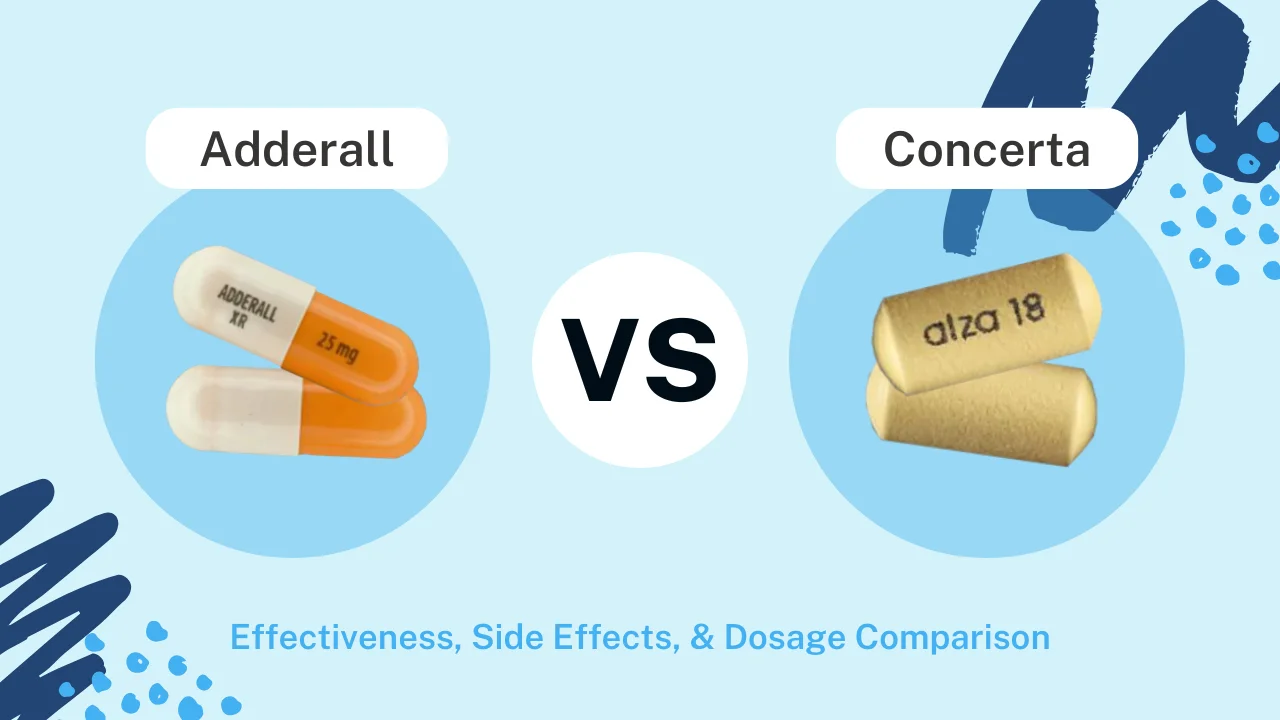
What is 27 mg of concerta equal to in adderall? 27 mg of Concerta is approximately equivalent to 10–15 mg of Adderall XR — most commonly cited as 15 mg in clinical conversion tables, using a factor of 0.55 (multiply the Concerta dose by 0.55 to estimate the Adderall XR equivalent). However, this conversion is an approximation that carries important clinical caveats: Concerta and Adderall are different drug classes with different mechanisms, different release architectures, and different individual response profiles. The number gives a starting point for prescriber-guided titration — it does not mean the two doses produce identical effects in a given individual.
Introduction
Questions about dose equivalence between ADHD medications are among the most practically important — and most misunderstood — topics patients encounter when their treatment changes. Whether you are switching from Concerta to Adderall, trying to understand a new prescription after a medication shortage, or simply trying to make sense of the dose difference between two medications in the same therapeutic category, knowing what 27 mg of Concerta equals in Adderall is a clinically real question that deserves a complete and honest answer.
This guide gives you the number, explains precisely where it comes from, outlines why it is an approximation rather than a reliable individual prediction, and covers everything you need to know about the differences between these two medications that make direct dose equivalence inherently imprecise.
The Conversion Number: Where It Comes From
The most widely cited clinical conversion table for Concerta and Adderall XR was published in a Medscape clinical reference based on prescribing data and appears in several prescribing guidelines:
| Concerta (methylphenidate ER) | Approximate Adderall XR equivalent |
|---|---|
| 18 mg | 10 mg |
| 27 mg | 15 mg |
| 36 mg | 20 mg |
| 54 mg | 30 mg |
| 72 mg | 40 mg |
The conversion factor used is approximately 0.55 — multiply the Concerta milligram dose by 0.55 to estimate the Adderall XR equivalent:
27 mg Concerta×0.55=14.85≈15 mg Adderall XR
A second widely used approach applies the general methylphenidate-to-amphetamine potency ratio — approximately 2:1 — meaning roughly 2 mg of methylphenidate produces equivalent clinical effect to 1 mg of amphetamine:
27 mg Concerta÷2=13.5≈13–14 mg Adderall
This gives a range of approximately 13–15 mg Adderall as the clinical estimate for 27 mg Concerta — most commonly rounded to 15 mg in practice for clean dose matching to available tablet sizes.
The Children’s Hospital of Pittsburgh prescribing guidelines for clinicians are explicit on the broader principle: “Adderall (amphetamine product) total daily dose is generally equivalent to ½ of Ritalin (methylphenidate product) dose”. Because Concerta is extended-release methylphenidate and Adderall XR is extended-release amphetamine, this 2:1 ratio is the foundational conversion.
Why This Conversion Is an Approximation, Not a Guarantee
This is the most important section in this article for anyone making a clinical decision based on this conversion.
The conversion from Concerta to Adderall is imprecise for several pharmacologically grounded reasons:
1. Different Drug Classes — Not Proportional at All Doses
Concerta contains methylphenidate — a drug that works primarily by blocking dopamine and norepinephrine reuptake transporters. Adderall contains mixed amphetamine salts — a drug that both blocks reuptake and actively releases dopamine and norepinephrine from nerve terminals. These are different mechanisms, not simply different concentrations of the same process.
There is no established, evidence-based cross-class conversion ratio between amphetamine and methylphenidate — the 2:1 ratio and the 0.55 factor are clinical estimates derived from prescribing experience and limited comparative data, not from controlled pharmacokinetic equivalence studies. The DROracle clinical pharmacology database states this directly: “There is no established, evidence-based conversion ratio between amphetamine (Adderall) and methylphenidate, and switching between these medications requires clinical re-titration”.
2. Different Release Mechanisms
Concerta uses the OROS (Osmotic Release Oral System) — a patented delivery mechanism that releases approximately 22% of the dose immediately and 78% via osmotic pressure over 10–12 hours, producing a gradually ascending concentration curve. This ascending profile is specifically designed to counteract tolerance development throughout the day.
Adderall XR uses a dual-bead release system — approximately 50% immediate release and 50% delayed release 4 hours later — producing a bimodal concentration curve with two identifiable peaks. These fundamentally different delivery architectures mean that even if total daily milligram equivalence could be established, the hour-by-hour concentration and effect profiles throughout the day are meaningfully different.
3. Individual Variation in Drug Metabolism
Methylphenidate and amphetamine are metabolised through different enzymatic pathways with different degrees of genetic variation between individuals. Some people are rapid metabolisers of one and slow metabolisers of the other — producing responses that deviate substantially from population-average conversion factors.
4. Clinical Data Supporting Different Equivalences
Practising clinicians and patients who have switched report meaningful variation from the published conversion ratios. The Children’s Hospital of Pittsburgh guidelines note that “Concerta 36 mg is not equal to Adderall XR 30 mg” and that “Adderall XR 30 mg equivalent to at least Concerta 54 mg (maybe 72 mg or higher)” — suggesting that in clinical practice the 2:1 ratio may underestimate Adderall’s advantage at higher doses. ADHD community experience includes patients who find 54 mg Concerta equivalent to 50 mg Adderall rather than 30 mg.
The practical clinical implication: Use the conversion as a reasonable starting point for discussing dose with your prescriber — not as a self-substitution guide. Any switch between these medications should involve prescriber-supervised re-titration over several weeks, not a one-time conversion calculation.
What 27 mg of Concerta Actually Is
Understanding the Concerta dose in its own right clarifies the comparison:
- 27 mg is Concerta’s second-lowest available dose, with tablets available in 18, 27, 36, and 54 mg
- It is an extended-release formulation lasting up to 12 hours — once-daily dosing
- The OROS delivery releases approximately 6 mg immediately (22% of 27 mg) and 21 mg over 10–12 hours via osmotic pump
- This produces a gradually ascending, relatively smooth concentration curve — different from the bimodal peak profile of Adderall XR
- 27 mg is typically used in children in early titration or adults with lower stimulant requirements
In the context of paediatric treatment, the prescribing targets are 1–2 mg/kg/day — so 27 mg Concerta is within the therapeutic range for a child weighing approximately 13–27 kg.
Concerta vs. Adderall: The Full Comparison
The Dose Conversion Table in Full Context
For patients at different Concerta doses wanting to understand the Adderall XR approximate equivalence, the full clinical table is:
| Concerta | Approx. Adderall XR equivalent (×0.55) | Approx. equivalent using 2:1 ratio |
|---|---|---|
| 18 mg | 10 mg | 9 mg |
| 27 mg | 15 mg | 13–14 mg |
| 36 mg | 20 mg | 18 mg |
| 54 mg | 30 mg | 27 mg |
| 72 mg | 40 mg | 36 mg |
Both methods converge on similar estimates, with the 0.55 factor table producing slightly higher Adderall equivalents. Adderall XR comes in 5, 10, 15, 20, 25, and 30 mg capsules — meaning the nearest available dose to the 27 mg Concerta equivalent is the 15 mg Adderall XR capsule.
Clinical Scenarios Where This Conversion Matters
Scenario 1: Switching From Concerta to Adderall
If you are switching from 27 mg Concerta to Adderall XR because of medication unavailability, preference, or inadequate response, 15 mg Adderall XR is the appropriate starting point for discussion with your prescriber. However, because individual response to the different mechanisms varies, your prescriber will likely want to titrate from that starting point — not assume the conversion is exact.
Scenario 2: Concerta Shortage (Relevant in Australia)
Australia has experienced documented methylphenidate shortages affecting Concerta and Ritalin supply. In this context, patients on 27 mg Concerta may need to temporarily substitute another medication. The prescribing guidance in shortage scenarios involves considering the methylphenidate-to-amphetamine conversion and initiating at a conservative equivalent dose with close follow-up.
Scenario 3: Understanding Relative Dose Position
For a patient on 27 mg Concerta wondering whether their dose is equivalent to being on a “low,” “medium,” or “high” Adderall dose — 15 mg Adderall XR represents a low-to-mid range dose (available doses go up to 30 mg XR, with some patients combining XR with IR boosters). 27 mg Concerta is similarly in the low-to-mid range of that medication’s 18–54 mg available scale.
Why the Conversion Should Never Be Used for Self-Dosing
This section is clinically non-negotiable to include.
Cross-class stimulant conversions carry meaningful risk when applied without prescriber guidance:
- Under-dosing risk: Starting too low produces a period of inadequate ADHD symptom control, which affects function and — in children — school performance
- Over-dosing risk: Starting too high introduces cardiovascular stress, anxiety amplification, insomnia, and potential for serious adverse effects
- Drug interaction context: A prescriber switching your medication will also review other medications, cardiovascular history, and current side effect profile — none of which a conversion table can account for
- Formulation mismatch: Taking 15 mg Adderall IR instead of 15 mg Adderall XR (because of capsule availability) produces a completely different pharmacokinetic profile than the conversion table assumes — 15 mg IR covers 4–6 hours, not 10–12
The ADHD medication calculator at adhdmedcalc.com — a tool specifically built for prescribers — carries a prominent disclaimer that it “will be used only as a reference aid” and that outputs “are not intended to substitute for clinical judgment”. The tool exists to inform prescriber decisions, not to enable patient self-direction of dose changes.
Australian Context
Adderall is not available in Australia. For Australian patients, this conversion question arises in two main practical contexts:
- Switching from Concerta to dexamphetamine or Vyvanse — both are TGA-approved and PBS-listed. The dexamphetamine conversion applies the same general 2:1 methylphenidate-to-amphetamine ratio as the Adderall conversion (since dexamphetamine is pure dextroamphetamine, which is Adderall’s primary active component) — 27 mg Concerta ≈ 13–15 mg dexamphetamine as a starting estimate
- During methylphenidate shortages — which have affected Australian supply of Ritalin and Concerta. In shortage situations, TGA and prescriber guidance recommends specialist-supervised switching with conservative dose initiation and close monitoring
All ADHD medication changes in Australia require specialist prescriber involvement — Schedule 8 controlled substance regulations require specialist prescription, and dose changes should always occur within that supervised relationship.
Common Misconceptions
Myth 1: “If 27 mg Concerta works for me, 15 mg Adderall XR will feel exactly the same.”The conversion estimates equivalent therapeutic effect at a population level — it does not predict that two individuals will experience the same effect, or that the same individual will experience identical effects from both drugs. Different mechanisms, different release curves, and individual metabolic variation mean that some patients find the converted dose too low, some too high, and some approximately right.
Myth 2: “27 mg Concerta is a very low dose.”27 mg is Concerta’s second-lowest available dose and is appropriate for children in early titration or adults at the lower end of their therapeutic range. Whether any dose is “low” is always relative to the individual patient’s therapeutic response — some patients achieve full ADHD symptom control at 27 mg; others require 54 mg.
Myth 3: “More mg always means more effective.”Stimulant medications have an inverted-U dose-response curve — above the therapeutic optimum, increasing dose produces side effects without additional therapeutic benefit, or produces overstimulation. The right dose is the lowest dose that produces adequate ADHD symptom control with acceptable side effects — not the highest dose available.
Myth 4: “The conversion factor works both ways — 15 mg Adderall XR converts back to exactly 27 mg Concerta.”Dose conversion between drug classes is inherently directional and approximate. The 0.55 factor applied to Concerta gives an Adderall XR starting estimate; going from Adderall back to Concerta involves a different titration process, not simply reversing the multiplication. All switches between these medications should be prescriber-guided regardless of direction.
FAQ — What Is 27 mg of Concerta Equal to in Adderall?
What is 27 mg Concerta equal to in Adderall?Using the clinical conversion factor of 0.55, 27 mg Concerta is approximately equivalent to 15 mg Adderall XR. Using the general 2:1 methylphenidate-to-amphetamine potency ratio, the estimate is 13–14 mg. Both approaches converge on 13–15 mg as the clinical estimate, with 15 mg being the nearest available Adderall XR capsule size.
Is the Concerta-to-Adderall conversion reliable?It is a useful clinical starting estimate — not a pharmacokinetically validated equivalence. There is no established evidence-based cross-class conversion between methylphenidate and amphetamine. The 2:1 and 0.55 factors are derived from prescribing experience and limited comparative data. Individual patients vary significantly in their response, and any switch requires prescriber-supervised re-titration.
Why does Concerta require a higher milligram dose than Adderall for equivalent effect?Because methylphenidate (Concerta) is approximately half as potent as amphetamine (Adderall) per milligram — as a reuptake inhibitor only, it does not additionally release dopamine from nerve terminals the way amphetamine does. A larger milligram amount of methylphenidate is therefore needed to achieve equivalent dopamine and norepinephrine elevation to a smaller amphetamine dose.
Can I use the conversion to switch medications myself?No — cross-class stimulant switches should always be prescriber-guided. The conversion gives you a starting point for the conversation with your prescriber, not a safe self-substitution formula. Cardiovascular history, co-occurring conditions, other medications, and current side effect profile all factor into a safe switch.
How does the Concerta OROS release system differ from Adderall XR’s?Concerta’s OROS system releases 22% of the dose immediately and delivers the remaining 78% via osmotic pressure through a laser-drilled orifice in the tablet coat — producing a gradually ascending concentration curve over 10–12 hours. Adderall XR releases approximately 50% of the dose immediately and 50% four hours later via a dual-bead system — producing a bimodal (two-peak) concentration curve. These different curves mean the two medications feel distinctly different through the day even when producing equivalent overall coverage.
Is Concerta or Adderall better for children vs. adults?Methylphenidate (Concerta) is generally the guideline-preferred first-line stimulant in children — it has a more extensive paediatric evidence base and is typically better tolerated in younger patients. Adderall XR is more commonly used in adults, where amphetamine-class medications show a slight efficacy edge per large meta-analyses. This is a population-level preference — individual patients of any age can respond better to either class.
Is Concerta available in Australia? What about Adderall?Concerta is TGA-approved and PBS-listed in Australia. Adderall is not TGA-approved in Australia and cannot be legally prescribed or imported. Australian patients on Concerta who need to switch to an amphetamine-class medication have access to dexamphetamine and Vyvanse via specialist prescription.
The Bottom Line
27 mg of Concerta is approximately equivalent to 15 mg of Adderall XR using the clinical 0.55 conversion factor, or 13–14 mg using the general 2:1 methylphenidate-to-amphetamine potency ratio — with 15 mg being the nearest available Adderall XR capsule size. This conversion reflects the approximately two-fold greater milligram potency of amphetamine over methylphenidate, derived from amphetamine’s dual mechanism of releasing and blocking reuptake of dopamine versus methylphenidate’s reuptake-inhibition-only mechanism. The number is a clinically useful starting estimate for prescriber-guided titration — not a guaranteed equivalence, not a self-dosing formula, and not a predictor of identical clinical experience between two different drug classes with different release architectures and individual response profiles. For Australian patients, Adderall is unavailable; the equivalent conversion applies to dexamphetamine, and all switches require specialist prescriber involvement.
What is 27 mg of Concerta equal to in Adderall Hobart
What is 27 mg of Concerta equal to in Adderall Devonport
What is 27 mg of Concerta equal to in Adderall Launceston
What is 27 mg of Concerta equal to in Adderall Tasmania
What is 27 mg of Concerta equal to in Adderall Victoria
What is 27 mg of Concerta equal to in Adderall Queensland
What is 27 mg of Concerta equal to in Adderall Canberra
What is 27 mg of Concerta equal to in Adderall Australian Capital Territory
What is 27 mg of Concerta equal to in Adderall South Australia
What is 27 mg of Concerta equal to in Adderall New South Wales
What is 27 mg of Concerta equal to in Adderall Darwin
What is 27 mg of Concerta equal to in Adderall Ghan
What is 27 mg of Concerta equal to in Adderall Northern Territory
What is 27 mg of Concerta equal to in Adderall Australia
What is 27 mg of Concerta equal to in Adderall Austria
What is 27 mg of Concerta equal to in Adderall Germany
What is 27 mg of Concerta equal to in Adderall United Kingdom
What is 27 mg of Concerta equal to in Adderall Sweden
What is 27 mg of Concerta equal to in Adderall Denmark
What is 27 mg of Concerta equal to in Adderall Norway
What is 27 mg of Concerta equal to in Adderall Finland
What is 27 mg of Concerta equal to in Adderall Iceland
What is 27 mg of Concerta equal to in Adderall Netherlands
What is 27 mg of Concerta equal to in Adderall Spain
What is 27 mg of Concerta equal to in Adderall Ireland
What is 27 mg of Concerta equal to in Adderall Switzerland
