
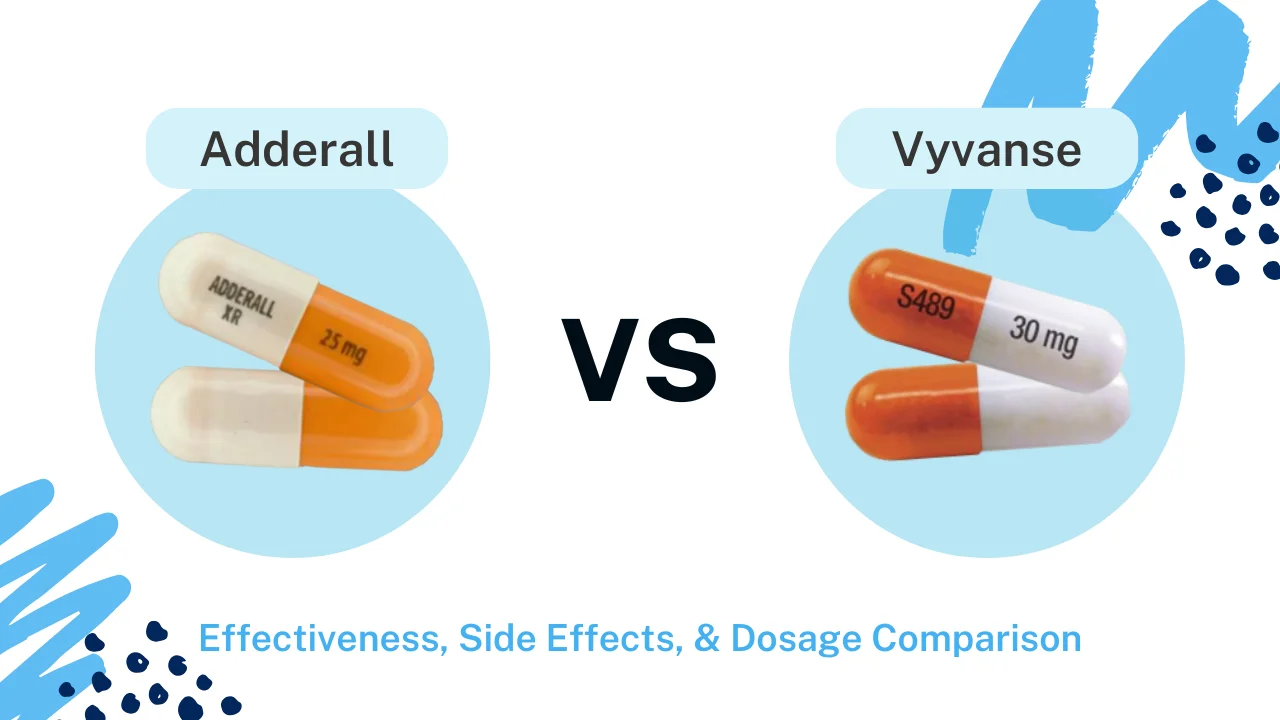
Is Vyvanse Adderall? No — Vyvanse is not the same as Adderall, but they are closely related. Both are amphetamine-based stimulant medications used to treat ADHD, and both ultimately raise dopamine and norepinephrine in the brain. The critical difference is that Vyvanse is a prodrug — it is pharmacologically inert until the body converts it into active dextroamphetamine through enzymatic metabolism. Adderall’s amphetamine components are immediately active upon absorption. This single distinction drives nearly every meaningful practical difference between them.
Introduction
Vyvanse and Adderall are the two most commonly confused ADHD medications — and with good reason. They both contain amphetamines, they both treat ADHD through the same neurotransmitter pathway, and for many patients they feel broadly similar. But they are not the same drug, and the differences between them have real clinical consequences: for how long they work, how smoothly they work, how they feel at onset and offset, their abuse potential, their side effect profiles, and — critically for Australians — their legal availability.
This guide gives you the complete picture: what’s the same, what’s genuinely different, what the research shows about which performs better, and how to make sense of the choice between them in clinical practice.
What You Need to Know First
Both Vyvanse and Adderall belong to the amphetamine class of central nervous system stimulants and are classified as Schedule II controlled substances. Both treat ADHD by increasing dopamine and norepinephrine in the prefrontal cortex, improving attention regulation, impulse control, and executive function.
The single most important difference:
- Adderall contains mixed amphetamine salts (75% dextroamphetamine, 25% levoamphetamine) in their already-active form — they begin working as soon as they are absorbed into the bloodstream
- Vyvanse contains lisdexamfetamine — a prodrug that is pharmacologically inactive until it is cleaved by red blood cell enzymes into dextroamphetamine and the amino acid lysine
This prodrug mechanism is not a trivial pharmaceutical distinction. It determines Vyvanse’s smoother onset, longer and more consistent duration, lower abuse potential, and — for some people — significantly better tolerability profile.
Head-to-Head: Vyvanse vs. Adderall
The Prodrug Mechanism: Why It Changes Everything
Understanding what “prodrug” means in practice is the most important piece of information for comparing these two medications.
When Adderall is swallowed, its amphetamine components begin absorbing and acting on the brain within 30 minutes — there’s no conversion step. This produces a relatively fast, noticeable onset, and a characteristic peak-and-trough concentration curve.
When Vyvanse is swallowed, nothing pharmacologically active happens immediately. The lisdexamfetamine molecule reaches the bloodstream, where red blood cell enzymes gradually cleave the lysine from the molecule, releasing active dextroamphetamine slowly and consistently. This enzymatic conversion process is rate-limited — meaning the body can only convert a fixed amount at a time, regardless of how much Vyvanse is taken.
What the prodrug mechanism produces in practice:
- Slower, gentler onset — the gradual conversion means the “kick” of medication arrival is less abrupt and less noticeable as a distinct on/off event
- Longer, more stable duration — because conversion is rate-limited and gradual, plasma dextroamphetamine concentration stays consistent for longer before tapering
- Softer offset and less pronounced crash — the gradual taper in dextroamphetamine levels produces a much gentler come-down than Adderall IR’s relatively sharp drop
- Lower abuse potential — because crushing, snorting, or injecting Vyvanse does not accelerate the enzymatic conversion step, there is no route-of-administration advantage for misuse; the drug produces the same gradual release regardless
This last point is the reason Vyvanse was specifically designed as a prodrug — Shire Pharmaceuticals (now Takeda) developed the lisdexamfetamine formulation partly to create an amphetamine with a lower misuse profile than immediate-release Adderall.
Does Vyvanse Feel Different From Adderall?
Among patients who have taken both, the experiential differences are consistent and widely reported:
- Adderall IR tends to feel more distinctly “on” and “off” — the medication’s arrival is noticeable, the peak is clear, and the wearing-off period (especially crash) is pronounced
- Vyvanse tends to feel more like a gradual change in cognitive state — patients often describe it as more subtle in onset, more seamlessly consistent through the day, and with a much softer evening tapering
- Patients who found Adderall IR’s crash distressing frequently report significantly better tolerability on Vyvanse for this reason alone
- Patients who found Adderall IR too strong or anxiety-inducing sometimes find Vyvanse’s gradual onset produces less acute anxiety during peak effects
- Some patients, conversely, find Vyvanse’s slower onset unsatisfying — preferring the faster, clearer effect of Adderall IR for tasks requiring immediate cognitive engagement
These experiential differences map directly onto the pharmacokinetic differences — they are not placebo effects or perception artefacts, but reflections of genuinely different concentration curves in the brain.
Efficacy: Does One Work Better Than the Other?
Clinical trial evidence consistently shows both Vyvanse and Adderall XR to be highly effective for ADHD, with no definitive head-to-head superiority for either in terms of core ADHD symptom reduction.
Both significantly outperform placebo in randomised controlled trials on inattention, hyperactivity-impulsivity, and executive function measures. Where studies have compared them directly, effect sizes are similar. The Lancet Psychiatry network meta-analysis — the largest comparative analysis of ADHD medications — did not separate Vyvanse from Adderall as significantly different in overall efficacy.
The efficacy distinction that does exist is in duration and consistency of coverage:
Vyvanse’s 10–14 hour profile provides therapeutic coverage more reliably through the late afternoon and evening than Adderall XR’s 10–12 hour profile. For adults with demanding schedules who need consistent afternoon and evening coverage, this difference is clinically meaningful. For patients who want medication to clear earlier in the day to allow natural evening winding down, Adderall XR’s slightly shorter coverage may be preferred.
Vyvanse has one FDA-approved use Adderall does not: moderate-to-severe binge eating disorder (BED). This is a clinically distinct indication from ADHD, and the only amphetamine-class medication approved for this purpose.
Side Effects: Similar Base, Meaningful Differences
Because both ultimately deliver dextroamphetamine (or mixed dextro/levo amphetamine in Adderall’s case), the side effect profiles overlap substantially:
Shared side effects of both:
- Appetite suppression and weight loss
- Insomnia — worse with late dosing
- Dry mouth
- Elevated heart rate and blood pressure
- Anxiety, irritability, mood changes
- Headaches
- Nausea
- Dependence and misuse potential
Where they differ:
- The crash is substantially less severe on Vyvanse — the gradual tapering of dextroamphetamine concentration produces a much softer decline than Adderall IR’s sharper drop, and notably softer than Adderall XR’s offset
- Anxiety during peak effects is typically less pronounced on Vyvanse given the slower, more gradual concentration rise — patients prone to stimulant-induced anxiety often tolerate Vyvanse better
- Appetite suppression may be somewhat less severe on Vyvanse in some patients due to its gradual release preventing the sharp concentration peak that drives the strongest appetite suppression with Adderall IR
- Cardiovascular spikes (elevated heart rate, blood pressure) may be less pronounced with Vyvanse given its more gradual concentration curve — Adderall IR’s sharp peak produces more noticeable cardiovascular activation
- Constipation and stomach pain are listed as additional Vyvanse side effects not commonly associated with Adderall specifically
- Priapism, Raynaud’s phenomenon, and seizures appear as additional rare serious side effects associated with Adderall but not specifically listed for Vyvanse — though the overall vasoconstriction risk is present in both amphetamine-class drugs
Abuse Potential: A Meaningful Difference
Both are Schedule II controlled substances with recognised misuse potential — this is not different in any legally relevant sense. However, Vyvanse’s prodrug mechanism provides a genuine pharmacological barrier to certain routes of misuse.
Because lisdexamfetamine requires enzymatic conversion that can only occur at a limited rate regardless of dose, crushing and snorting Vyvanse does not produce the fast, intense dopamine surge that makes immediate-release amphetamines appealing for misuse. The conversion step is the bottleneck — there is no way to bypass it through route of administration.
This is pharmacologically meaningful: the fast dopamine spike from snorted or insufflated Adderall IR produces a more intense and more reinforcing reward signal, driving the feedback loop of misuse more aggressively. Vyvanse, being incapable of producing this fast spike regardless of how it is administered, has a structurally lower misuse reinforcement profile.
In practical clinical terms: for patients with a personal or family history of substance use disorder, or for prescribers managing ADHD in high-risk settings, Vyvanse’s lower misuse potential is a clinically relevant advantage.
Cost and Accessibility
Adderall:
- Generic amphetamine salts are widely available in the USA, significantly reducing cost
- Not available in Australia at all — not TGA-approved
Vyvanse:
- Remains under patent protection — no generic available, making it significantly more expensive than generic Adderall in markets where both are sold
- Available in Australia on the PBS under specialist prescription, making it significantly more affordable for PBS-eligible patients than out-of-pocket pricing would suggest
- PBS-listed in Australia for ADHD in children (6+ years) and adults under specific criteria
For Australian patients, Vyvanse is the more accessible of the two — and is one of only two amphetamine-class ADHD medications available in Australia (the other being dexamphetamine).
Australian Context: What This Means in Practice
Adderall is not available in Australia — not TGA-approved, cannot be legally prescribed, and importing it carries serious legal consequences.
Vyvanse is TGA-approved and PBS-listed in Australia. For Australian patients and clinicians, the “Vyvanse vs. Adderall” comparison is therefore largely academic in terms of clinical decision-making — the real Australian choice is between:
- Vyvanse (lisdexamfetamine) — smooth, long-acting, lower abuse potential, PBS-listed
- Dexamphetamine — pure dextroamphetamine, available in IR and some SR forms, the closest Australian equivalent to Adderall IR in its felt profile, available by specialist prescription
- Methylphenidate (Ritalin, Concerta) — different drug class, also PBS-listed, discussed in the previous article
For Australians who have read about Adderall and are wondering whether it would work better than their current medication, the most clinically relevant question is whether dexamphetamine (which delivers the same active molecule as Adderall — dextroamphetamine — without the levo-isomer component) would be worth trialling alongside or instead of Vyvanse.
All require specialist (psychiatrist or paediatrician) prescription in Australia.
Common Misconceptions
Myth 1: “Vyvanse is just long-acting Adderall.”This is the most common oversimplification — and it misses the most important difference. Vyvanse is not simply a slow-release capsule of Adderall. It is a chemically distinct prodrug that is entirely inactive until metabolised — the mechanism of action, the rate of activation, and the ceiling on how fast it can be activated are fundamentally different from Adderall XR’s bead-based delayed release.
Myth 2: “Vyvanse is safer than Adderall.”Both are Schedule II controlled substances with significant misuse and dependence potential, and with comparable cardiovascular, psychiatric, and other serious risk profiles. Vyvanse has lower misuse potential through certain routes, but it is not categorically safer — it is not appropriate to use without proper assessment and monitoring.
Myth 3: “If Adderall worked for me, Vyvanse will work the same way.”Because Vyvanse delivers only dextroamphetamine (not the levo-isomer present in Adderall), and because its delivery is gradual rather than rapid, the felt experience and the optimal dose calibration are genuinely different. Switching between them requires prescriber-guided re-titration and a period of adjustment — it is not a direct substitution.
Myth 4: “I can get Adderall from overseas since Vyvanse is too expensive.”Importing Adderall into Australia without TGA approval is a serious criminal offence regardless of whether you have an overseas prescription. For patients concerned about Vyvanse cost, PBS eligibility through a specialist prescription and discussion of dexamphetamine as an alternative are the appropriate clinical pathways.
FAQ — Is Vyvanse Adderall?
Is Vyvanse the same as Adderall?No — they are related but distinct medications. Both are amphetamine-class CNS stimulants that raise dopamine and norepinephrine to treat ADHD, but their active ingredients differ: Vyvanse contains lisdexamfetamine (a prodrug requiring enzymatic conversion), while Adderall contains mixed amphetamine salts in immediately active form. The prodrug mechanism produces meaningfully different onset, duration, abuse potential, and tolerability profiles.
Does Vyvanse feel the same as Adderall?For most patients, no — the subjective experience is noticeably different. Adderall IR tends to produce a more distinct, noticeable “on” effect and a sharper crash; Vyvanse tends to feel more gradual in onset, more consistent through the day, and to taper more softly in the evening. Patients who found Adderall’s peaks and valleys disruptive frequently report significantly better daily consistency on Vyvanse.
Which is stronger — Vyvanse or Adderall?This comparison is complicated by the prodrug mechanism. Vyvanse converts entirely to dextroamphetamine — the more potent isomer. Adderall contains 75% dextroamphetamine and 25% levoamphetamine, with levo being less pharmacologically active. At equivalent doses, Vyvanse may produce slightly more pure dextroamphetamine effect per milligram, but its gradual release means the peak concentration is lower and more sustained than Adderall IR’s faster peak. Overall clinical potency is broadly comparable at therapeutic doses.
Which lasts longer — Vyvanse or Adderall?Vyvanse lasts longer — typically 10–14 hours compared to Adderall XR’s 10–12 hours, and significantly longer than Adderall IR’s 4–6 hours. For adults needing consistent afternoon and evening coverage, Vyvanse’s longer and smoother duration is a clinical advantage.
Which has lower abuse potential — Vyvanse or Adderall?Vyvanse — due to its prodrug mechanism. Because lisdexamfetamine cannot be activated faster by changing the route of administration (crushing, snorting, injecting), it does not produce the rapid dopamine spike that drives the reinforcing effect of stimulant misuse. Both remain Schedule II substances with significant dependence risk at prolonged therapeutic or above-therapeutic use, but Vyvanse’s misuse reinforcement profile is structurally lower.
Is Vyvanse available in Australia? What about Adderall?Vyvanse is TGA-approved and PBS-listed in Australia for ADHD treatment. Adderall is not TGA-approved and cannot be legally prescribed in Australia. For Australian patients considering the equivalent of the Adderall vs. Vyvanse comparison, the practical clinical choice is between Vyvanse, dexamphetamine, and methylphenidate-based medications — all of which require specialist prescription.
Can I switch from Adderall to Vyvanse (or vice versa)?Switching between them is a standard clinical practice that requires prescriber guidance and dose re-titration — they are not directly interchangeable at the same milligram dose. The conversion is approximately Vyvanse 30 mg ≈ Adderall XR 10–15 mg as a starting estimate, but individual response varies and a titration period is needed. Any switch should be managed by the prescribing clinician.
Why is Vyvanse more expensive than Adderall?Vyvanse remains under patent protection — no generic lisdexamfetamine is currently available, which means there is no market competition to reduce its price. Generic amphetamine salts (Adderall’s active ingredient) are widely available and substantially cheaper in markets where they can be sold. In Australia, PBS listing makes Vyvanse significantly more affordable for eligible patients than the out-of-pocket market price would suggest.
The Bottom Line
Vyvanse is not Adderall — it is a pharmacologically distinct prodrug that converts to dextroamphetamine in the body, producing a smoother, longer, and more consistent effect with a softer onset and offset, lower acute abuse potential, and generally better tolerability profile compared to Adderall IR. Adderall’s active-immediate formulation acts faster, clears faster, is available in both IR and XR forms, has generic options that reduce cost, and is the only amphetamine-class ADHD medication approved for narcolepsy. Neither is clinically superior across all parameters — the choice between them depends on individual response, schedule requirements, tolerability, and misuse risk profile. For Australian patients, Adderall is unavailable by law; Vyvanse is the accessible amphetamine-class option, and its PBS listing makes it the practical first-choice amphetamine-based stimulant for ADHD treatment in Australia.
Is Vyvanse Adderall Hobart
Is Vyvanse Adderall Devonport
Is Vyvanse Adderall Launceston
Is Vyvanse Adderall Tasmania
Is Vyvanse Adderall Victoria
Is Vyvanse Adderall Queensland
Is Vyvanse Adderall Canberra
Is Vyvanse Adderall Australian Capital Territory
Is Vyvanse Adderall South Australia
Is Vyvanse Adderall New South Wales
Is Vyvanse Adderall Darwin
Is Vyvanse Adderall Ghan
Is Vyvanse Adderall Northern Territory
Is Vyvanse Adderall Australia
Is Vyvanse Adderall Austria
Is Vyvanse Adderall Germany
Is Vyvanse Adderall United Kingdom
Is Vyvanse Adderall Sweden
Is Vyvanse Adderall Denmark
Is Vyvanse Adderall Norway
Is Vyvanse Adderall Finland
Is Vyvanse Adderall Iceland
Is Vyvanse Adderall Netherlands
Is Vyvanse Adderall Spain
Is Vyvanse Adderall Ireland
Is Vyvanse Adderall Switzerland
