
Does adderall increase sex drive? Adderall can both increase and decrease sex drive — and both outcomes are real, documented, and can occur in the same person at different doses or times. At lower therapeutic doses, elevated dopamine can heighten desire and sexual presence. At higher doses or with long-term use, vasoconstriction, overstimulation, and dopamine dysregulation more commonly suppress libido. The direction of the effect is dose-dependent, individual, and often shifts over time.
Introduction
Few Adderall side effects generate more confusion — or more online searching — than its effects on sex drive. People starting the medication discover their libido has either disappeared or become overwhelming, often without warning. Partners notice. Relationships are affected. And yet most prescribers don’t bring it up during medication consultations.
This guide covers both directions honestly: how and why Adderall can increase sexual desire, how and why it suppresses it, what physical mechanisms produce each outcome, and — critically — what you can actually do when either experience is disrupting your life.
What You Need to Know First
Adderall acts on two neurotransmitters that are directly involved in sexual function: dopamineand norepinephrine. Dopamine is the brain’s primary reward and motivation signal — it drives desire, anticipation of pleasure, and the experience of arousal. Norepinephrine activates the sympathetic nervous system, which governs physical arousal responses. Because Adderall manipulates both simultaneously, its effects on sexual function are inherently unpredictable in direction — they depend on dose, individual neurochemistry, timing, relationship context, and how long the medication has been taken.
Key facts:
- Sexual side effects from Adderall are relatively uncommon overall, but when they occur, they are significant enough to affect quality of life
- Both increased and decreased libido are officially recognised side effects
- The same person can experience increased libido at a lower dose and decreased libido at a higher dose
- Effects often change over time — initial hypersexuality frequently normalises; initial libido suppression may improve as the body adapts
- Physical sexual dysfunction (erectile difficulties, trouble with arousal or orgasm) is mechanistically separate from libido changes — both can occur independently
- Research on female sexual side effects of Adderall is substantially more limited than male-focused research
Why Adderall Can Increase Sex Drive
For some users — particularly at lower doses early in treatment — Adderall produces a noticeable increase in sexual desire. Several mechanisms explain this:
Elevated Dopamine Heightens Sexual Desire
Dopamine is the primary neurochemical driver of sexual motivation. When Adderall raises dopamine levels above baseline, it activates the same reward pathways that respond to sexual stimulation. The result, particularly at doses that produce pleasure without overwhelming the system, can be heightened sexual interest, stronger arousal, and more intense orgasm.
This dopamine-enhanced desire is most pronounced in people with ADHD whose dopamine system was chronically under-stimulated before medication. Correcting that deficit doesn’t just improve focus — it restores motivational drive across multiple domains, including sexual desire.
Improved Presence and Focus During Sex
One of the most consistent findings from patient accounts is that Adderall can dramatically improve the quality of sexual experience by improving the ability to be mentally present. Many people with ADHD describe sex before medication as mentally scattered — mind wandering, attention drifting, difficulty staying present with a partner. Adderall’s focus-enhancing effect addresses exactly this pattern, allowing full engagement with the experience rather than distracted participation.
As one psychologist specialising in ADHD and sexual health noted: users reporting a positive sexual effect on stimulants were likely less distracted during sex — and that reduction in cognitive interference was itself the mechanism of improvement.
Reduced Inhibitions and Social Anxiety
ADHD frequently co-occurs with social anxiety and reduced self-esteem driven by years of underperformance and ADHD-related failures. When Adderall effectively treats ADHD symptoms, mood, confidence, and self-perception often improve. Reduced anxiety and better self-esteem are themselves independent drivers of increased sexual desire and more satisfying intimate experiences.
Stimulant-Driven Energy Increase
Adderall’s general stimulant properties — elevated energy, heightened physical arousal, reduced fatigue — can also translate to increased interest in physical activity including sex, particularly early in treatment when stimulant effects are most pronounced.
Why Adderall Can Decrease Sex Drive
Despite the above, decreased sex drive is the more commonly reported sexual side effect in clinical and anecdotal data — particularly at higher doses, with long-term use, and in women.
Vasoconstriction — The Physical Barrier
This is the most direct physical mechanism of Adderall-related sexual dysfunction. Adderall stimulates alpha-adrenergic receptors, causing smooth muscle in blood vessel walls throughout the body to contract. This vasoconstriction reduces blood flow to the genitals — the same blood flow that is essential for erection in men and physical arousal in women.
The result is a striking paradox: Adderall can increase the mental desire for sex while simultaneously making physical response more difficult. A man may feel interested but unable to achieve or maintain erection. A woman may experience desire but reduced physical arousal or difficulty with orgasm. This disconnect between mental interest and physical capacity is one of the most frustrating and confusing sexual experiences Adderall produces.
Overstimulation Redirects Dopamine Away From Sex
At higher doses — or in people whose baseline dopamine is already at normal levels — Adderall’s dopamine surge can redirect focus away from sex entirely. When the brain is highly stimulated and engaged in a task, sexual motivation competes poorly for attention. Multiple patient accounts describe this precisely: at a lower dose, sex felt appealing and engaging; at a higher dose, nothing competed with work focus, and sexual interest disappeared entirely.
Long-Term Dopamine Receptor Downregulation
Chronic Adderall use causes the brain to downregulate dopamine receptor density — a compensatory response to persistent overstimulation. Over time, this can reduce the brain’s natural capacity for reward response, including sexual pleasure and desire. This is why some users who initially experienced increased libido find it gradually declining with months of continued use.
Hormonal Effects — Particularly in Women
Adderall’s influence on cortisol, norepinephrine, and potentially oestrogen levels adds a hormonal dimension to its sexual side effects. In women, low oestrogen is directly associated with reduced sexual desire and physical arousal. Some evidence suggests stimulant medications can interact with oestrogenic activity — potentially contributing to libido reduction in female users. This mechanism is not fully characterised in the research, but it aligns with clinical observations that women on stimulant ADHD medication disproportionately report decreased libido and difficulty with arousal.
Emotional Blunting and Detachment
Some long-term Adderall users report a general emotional flattening — reduced spontaneity, narrowed emotional range, difficulty fully engaging with intimacy. This emotional detachment is not unique to sexual experience, but it affects it significantly. When the warmth and emotional openness that characterises genuine intimacy is dampened by overstimulation or receptor downregulation, sex may feel mechanical or uninteresting even when desire is present.
The Dose-Dependency: Why It Goes Both Ways
The dose relationship is the single most important variable in predicting which direction Adderall pushes libido:
This dose-dependency is why the same medication can feel like an aphrodisiac to one person and a libido-killer to another — and why the same person can experience both effects at different times.
Effects on Men vs. Women
Men
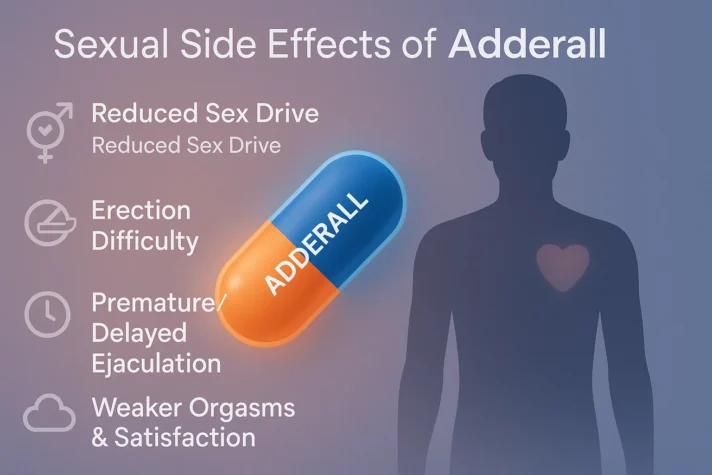
In men, the most commonly reported sexual side effects are erectile dysfunction and reduced libido. Adderall-induced ED is estimated to affect approximately 30–40% of men taking the medication, though this figure includes all degrees of dysfunction, from occasional difficulty to complete inability. The mechanism — vasoconstriction reducing penile blood flow — is direct and well characterised. Delayed ejaculation and premature ejaculation have also been reported, though less commonly. The good news: Adderall-related ED is typically reversible, with most men experiencing improvement within days to weeks of dose reduction or discontinuation.
Some men report the opposite — increased libido, more frequent erections, and enhanced sexual experience — particularly at lower doses or early in treatment.
Women
Research on Adderall’s sexual effects in women is substantially more limited. Available evidence and clinical reports suggest the most common effects are reduced libido and difficulty with arousal — consistent with the vasoconstriction and hormonal mechanisms described above. Some women report the opposite: increased desire and heightened sensitivity, particularly linked to dopamine elevation early in treatment.
The variability is at least as wide in women as in men, if not more so — and the mechanisms are less well understood. Women taking Adderall who notice any significant change in sexual function should bring it to their prescriber, as the hormonal dimension in particular may warrant a more tailored medication review.
ADHD, Hypersexuality, and Medication
Before attributing changes in sex drive entirely to medication, it’s worth acknowledging the pre-medication baseline. ADHD itself is associated with elevated sexual desire, higher frequency of sexual behaviour, and more sexual risk-taking — driven primarily by impulsivity, dopamine-seeking, and poor self-regulation rather than an intrinsically higher libido.
Research confirms that people with ADHD generally report higher sexual desire, more frequent masturbation, less sexual satisfaction, and more sexual dysfunction than the general population — all before medication. When stimulant medication is started, it can paradoxically reduce impulsive hypersexuality while improving overall sexual satisfaction — or it can amplify existing patterns if it intensifies dopamine reward signalling.
What this means practically: If sex drive increases dramatically after starting Adderall, it may be a medication effect — but it may also be an expression of untreated ADHD-related impulsivity that the medication has not yet adequately addressed. If sex drive decreases, it may also partly reflect the reduction of impulsive sexual drive that ADHD was generating — which is different from a true libido decrease.
What to Do If Adderall Is Affecting Your Sex Drive
If libido has increased to the point of being disruptive:
- Discuss with your prescriber — if hypersexuality is new and intrusive, this may signal the dose is too high for your neurobiology, or that timing needs adjustment
- Consider whether the increase reflects improved ADHD treatment or new hypersexual behaviour; these have different clinical implications
If libido has decreased or sexual dysfunction has developed:
- Request a dose review — the most common fix is a modest reduction in dose, which frequently restores sexual function without sacrificing ADHD symptom control
- Adjust timing — taking Adderall earlier in the day means it has largely cleared by evening, preserving natural sexual function during the time most people are intimate
- Discuss formulation alternatives — some patients find switching to non-stimulant ADHD medications (atomoxetine, guanfacine) resolves sexual side effects while maintaining therapeutic benefit
- Do not stop medication abruptly without prescriber guidance
- For men experiencing persistent ED: discuss whether the mechanism is vasoconstrictive (likely Adderall-related and reversible) or psychological (anxiety about performance, which is a separate and addressable issue)
- For women experiencing persistent low arousal: flag the possibility of hormonal contribution to your prescriber, as this may warrant a different assessment pathway
Safety and Legal Context for Australians
Adderall is not available in Australia — it is not TGA-approved and cannot be legally prescribed or dispensed by Australian healthcare providers. All sexual side effects described in this article apply equally to the TGA-approved equivalents: Vyvanse (lisdexamfetamine) and dexamphetamine share the same active components and the same dopamine/norepinephrine mechanisms that produce both libido-increasing and libido-decreasing effects.
For Australians experiencing sexual side effects from stimulant ADHD medication, the same clinical strategies apply — dose adjustment, timing changes, and alternative medication discussion should all go through the prescribing specialist. Importing Adderall from overseas carries serious legal consequences regardless of prescription status.
Common Misconceptions
Myth 1: “Adderall always kills sex drive.”This is the most common assumption — and it’s wrong for a meaningful proportion of users. Both increased and decreased libido are documented outcomes. The direction depends on dose, individual neurochemistry, ADHD presentation, and duration of use. Assuming suppression is universal has left many patients confused about why their experience doesn’t match what they read.
Myth 2: “If Adderall increases my sex drive, that means something is wrong.”Not necessarily. Elevated dopamine can produce increased desire as a direct pharmacological effect, and improved ADHD symptom control can improve sexual confidence and presence. An increase in sex drive is within the range of normal Adderall responses — it becomes clinically relevant only if it is distressing, impairing, or characterised by compulsive or risky behaviour.
Myth 3: “Adderall-caused erectile dysfunction is permanent.”Adderall-related ED is typically reversible and mechanistically linked to vasoconstriction during the drug’s active window. Most men experience improvement within days to weeks of dose reduction or stopping the medication. Permanent sexual dysfunction from Adderall at therapeutic doses is not supported by current evidence.
Myth 4: “These effects don’t matter enough to bring to my doctor.”Sexual health changes are clinically relevant, affect quality of life, and are almost always addressable through dosing or timing adjustments. Many patients don’t raise the issue because they feel embarrassed or assume nothing can be done — both assumptions are incorrect.
FAQ — Does Adderall Increase Sex Drive?
Does Adderall increase or decrease sex drive?Both outcomes are possible — and both are documented in clinical and patient literature. At lower doses, elevated dopamine frequently increases desire and improves sexual presence and enjoyment. At higher doses, vasoconstriction and overstimulation more commonly reduce physical arousal capacity and redirect focus away from sex. The direction of effect is determined by dose, individual neurochemistry, and duration of use, not a single universal outcome.
Why does Adderall make me hypersexual?Hypersexuality on Adderall is most commonly linked to dopamine elevation above baseline — particularly when the dose produces reward signalling that amplifies desire rather than simply correcting an ADHD deficit. It can also reflect ADHD-related impulsivity becoming more pronounced, or an incomplete management of the seeking and stimulation-craving that characterises ADHD. If hypersexuality is new, intrusive, or causing problems in relationships, it warrants a prescriber conversation about dose.
Why has Adderall killed my sex drive completely?Total libido loss on Adderall typically reflects one or more of: overstimulation redirecting dopamine away from sexual motivation; vasoconstriction impairing physical arousal response; emotional blunting from chronic dopamine receptor downregulation; or hormonal effects, particularly in women. A dose reduction, earlier timing, or formulation change resolves this for most people.
Can Adderall cause erectile dysfunction?Yes — through vasoconstriction of blood vessels supplying the penis, Adderall reduces the blood flow required for erection. This is estimated to affect approximately 30–40% of male Adderall users to some degree. It is typically reversible: most men experience improvement within days to weeks of dose reduction or stopping. Combining Adderall with other vasoconstrictive substances — extra caffeine, pre-workout stimulants — amplifies this risk.
Does Adderall affect sex drive differently in men and women?Yes, though the research is more limited for women. In men, the dominant clinical concerns are erectile dysfunction and reduced libido, both tied to vasoconstriction and dopamine disruption. In women, the most commonly reported effects are reduced libido and difficulty with arousal, with a possible hormonal dimension involving oestrogen. Some women also experience increased desire, particularly early in treatment. Both sexes show wide individual variability.
Does Adderall’s effect on sex drive change over time?Yes — frequently. Initial hypersexuality typically moderates as the brain adapts to elevated dopamine levels. Initial libido suppression sometimes improves as cardiovascular and hormonal systems stabilise. Long-term users, however, can develop progressive dopamine receptor downregulation that gradually reduces reward sensitivity including sexual desire. Regular reviews with a prescriber are the best way to catch and address these shifts.
Should I stop Adderall if it’s affecting my sex drive?Do not stop abruptly without speaking to your prescriber. Sexual side effects are very often addressed through dose adjustment, timing changes, or formulation alternatives — all of which preserve ADHD therapeutic benefit while resolving the sexual issue. Stopping abruptly risks a withdrawal-like period including mood depression and cognitive fog, and may not even be necessary to resolve the side effect.
The Bottom Line
Adderall’s relationship with sex drive is genuinely bidirectional — it can increase desire by elevating dopamine and improving presence, or decrease it through vasoconstriction, overstimulation, and receptor downregulation. The direction depends heavily on dose, with lower therapeutic doses more likely to enhance and higher doses more likely to suppress. Neither outcome is permanent, both are addressable, and both are worth raising with a prescriber rather than quietly tolerating. For Australians on Vyvanse or dexamphetamine experiencing the same effects, the same mechanisms and the same clinical solutions apply — these are conversations to have with your prescribing specialist, not situations to manage in silence.
Does Adderall increase sex drive Hobart
Does Adderall increase sex drive Devonport
Does Adderall increase sex drive Launceston
Does Adderall increase sex drive Tasmania
Does Adderall increase sex drive Victoria
Does Adderall increase sex drive Queensland
Does Adderall increase sex drive Canberra
Does Adderall increase sex drive Australian Capital Territory
Does Adderall increase sex drive South Australia
Does Adderall increase sex drive New South Wales
Does Adderall increase sex drive Darwin
Does Adderall increase sex drive Ghan
Does Adderall increase sex drive Northern Territory
Does Adderall increase sex drive Australia
Does Adderall increase sex drive Austria
Does Adderall increase sex drive Germany
Does Adderall increase sex drive United Kingdom
Does Adderall increase sex drive Sweden
Does Adderall increase sex drive Denmark
Does Adderall increase sex drive Norway
Does Adderall increase sex drive Finland
Does Adderall increase sex drive Iceland
Does Adderall increase sex drive Netherlands
Does Adderall increase sex drive Spain
Does Adderall increase sex drive Ireland
Does Adderall increase sex drive Switzerland
