
How to get adderall prescribed? To get Adderall prescribed, you need a formal ADHD diagnosis from a licensed healthcare provider — a primary care physician (PCP), psychiatrist, neurologist, nurse practitioner (NP), or physician assistant (PA) with a valid DEA registration. The provider conducts a comprehensive clinical evaluation, and if ADHD is confirmed and Adderall is deemed clinically appropriate, they issue a Schedule II controlled substance prescription. In 2026, this process can be completed entirely via telehealth in the US — no in-person visit is currently required under the DEA’s fourth temporary extension of COVID-era telehealth flexibilities, which runs through December 31, 2026.
Introduction
Getting Adderall prescribed is one of the most commonly searched questions in ADHD treatment — and one of the most anxiety-provoking. Many people with genuine ADHD symptoms worry about coming across as drug-seeking when they talk to a doctor. Others are confused about which type of provider to see, whether they need a specialist or a GP, and whether they need to go in person or can do it online.
This guide gives you the full, honest answer to all of those questions. It covers the clinical process, who can prescribe, what the evaluation involves, how to have the conversation with your doctor, the telehealth landscape in 2026, and the red flags that separate legitimate providers from predatory clinics.
Who Can Prescribe Adderall in the United States?
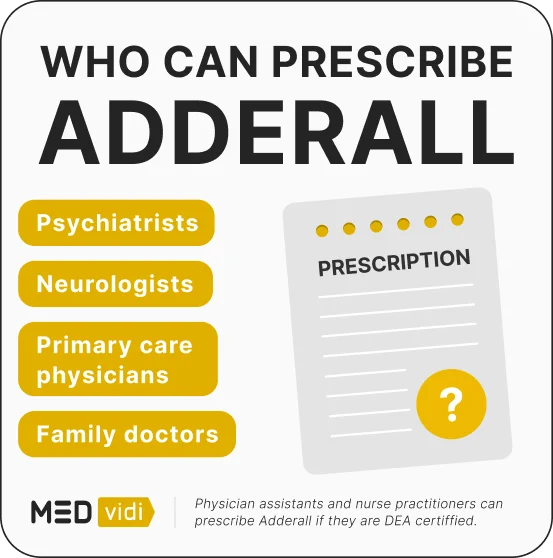
Adderall is a Schedule II controlled substance under the Controlled Substances Act — meaning it has recognised medical use but also significant potential for abuse. Several categories of licensed practitioners can legally prescribe it, provided they hold a valid DEA (Drug Enforcement Administration) registration number:
- Psychiatrists (MD or DO) — the specialists most experienced with ADHD diagnosis and stimulant management; generally preferred for complex presentations, co-occurring conditions, or cases where the diagnosis is unclear
- Primary Care Physicians (PCPs — MD or DO) — can diagnose ADHD and prescribe Adderall directly; appropriate for straightforward presentations, particularly for patients with established relationships with their GP
- Nurse Practitioners (NPs) and Physician Assistants (PAs) — can prescribe Schedule II substances in most states if they hold a DEA registration; NP prescriptive authority varies by state (full, reduced, or restricted practice authority)
- Neurologists — can diagnose and prescribe for ADHD, particularly useful where neurological differential diagnoses need to be explored
- Paediatricians — the standard prescribers for children; can initiate and manage Adderall in paediatric ADHD
The most important credential to verify is that the provider holds a valid DEA registration — this is the federal licence required to prescribe Schedule II controlled substances. You can verify a provider’s DEA registration through the DEA’s online lookup tool.
The Clinical Pathway: Step by Step
Step 1 — Choose Your Provider Type
Your first decision is which type of provider to see:
Go to a PCP if:
- Your symptoms are relatively clear-cut and you have an existing relationship with your doctor
- You do not have significant co-occurring mental health conditions (anxiety, depression, bipolar disorder) that would complicate the diagnosis
- You want a faster, lower-cost first step
Go to a psychiatrist if:
- Your presentation is complex — symptoms that could indicate ADHD, anxiety, depression, or another condition
- You have been evaluated before and want a specialist opinion on medication management
- Your PCP is not comfortable diagnosing or managing ADHD with stimulants
Go to a telehealth ADHD specialist if:
- You want the fastest possible access with the lowest logistical barriers
- You live in a rural or underserved area without convenient specialist access
- You want same-day or next-day appointments
Step 2 — Prepare for Your Evaluation
ADHD evaluation requires you to describe your symptoms in clinical detail. Before your appointment, prepare the following:
Symptom documentation:
- Specific examples of inattention, impulsivity, or hyperactivity affecting your daily life — at work, in relationships, managing finances, completing tasks
- How long these symptoms have been present (ADHD requires symptoms since childhood — before age 12 — even if you are being evaluated as an adult)
- Multiple settings where symptoms affect you — home, work, social situations
Prior records (if available):
- School reports, especially ones noting attention or behaviour concerns
- Prior ADHD or psychological evaluations
- Records of previous psychiatric treatment or medication trials
- Family history of ADHD (strong genetic heritability supports diagnosis)
Medical history:
- Current medications and supplements
- History of anxiety, depression, sleep disorders, thyroid conditions — conditions that can mimic ADHD
- Substance use history
Collateral information:
- A spouse, parent, sibling, or close friend who can corroborate your symptom history adds significant weight to an adult ADHD evaluation
- Many providers offer collateral questionnaires (e.g., the Conners Adult ADHD Rating Scale — observer version)
Step 3 — The Evaluation Itself
A thorough ADHD evaluation involves several components:
Clinical interview (30–90 minutes):The provider asks about your current symptoms, childhood history, academic and work performance, relationships, and daily functioning. The DSM-5 requires at least six symptoms of inattention and/or hyperactivity-impulsivity (five for adults 17 and older) that are present in multiple settings, cause significant impairment, and have been present since childhood.
Standardised rating scales:Validated questionnaires such as the Adult ADHD Self-Report Scale (ASRS-v1.1), Conners’ Adult ADHD Rating Scales (CAARS), or Brown ADHD Rating Scales are used to quantify symptom severity. These are not diagnostic in isolation but provide standardised, clinically validated data to support the clinician’s assessment.
Medical review:A physical exam or medical history review rules out medical causes of ADHD-like symptoms — thyroid dysfunction, anaemia, sleep apnoea, vision or hearing impairment.
Differential diagnosis review:The clinician assesses whether symptoms are better explained by anxiety, depression, bipolar disorder, learning disabilities, trauma (PTSD), or autism spectrum conditions — all of which can produce attention and executive function difficulties.
Outcome:At the end of the evaluation, the provider gives you their diagnostic conclusion and, if ADHD is confirmed, discusses treatment options — which may include Adderall, other stimulants, non-stimulant options, or behavioural therapy with or without medication.
Step 4 — Receiving the Prescription
If your provider diagnoses ADHD and determines Adderall is clinically appropriate, they issue a Schedule II prescription:
- In the US, Schedule II prescriptions cannot be phoned in or faxed — they must be electronic (e-prescriptions) or written
- Each prescription can cover up to a 30-day supply — Schedule II medications cannot carry repeat prescriptions in most states
- The FDA specifies that a prescription for Adderall is valid for up to 90 days’ worth of medication total if written for valid medical purposes — but practically, most providers write 30-day supplies with follow-up appointments
- Your prescription is sent electronically to your preferred pharmacy
The Telehealth Pathway in 2026
In 2026, the fastest and most accessible route to an Adderall prescription in the US is through a telehealth ADHD provider:
The Ryan Haight Act and Current Flexibilities
The Ryan Haight Online Pharmacy Consumer Protection Act of 2008 normally requires an in-person medical evaluation before a provider can prescribe a controlled substance via telehealth. However, the DEA and HHS issued a fourth temporary extension of COVID-era telehealth flexibilities, effective January 1 through December 31, 2026:
- Schedule II–V controlled substances (including Adderall) can be prescribed via audio-video telehealth without any prior in-person evaluation
- This means a new patient can receive an Adderall prescription from a telehealth provider in a single video consultation — no in-person visit required
- These flexibilities expire December 31, 2026 — permanent DEA rules are anticipated before this date
Practical implication: In 2026, getting Adderall prescribed via telehealth is legally straightforward — a qualified provider can complete a full evaluation and issue a prescription in a single video appointment. This represents a significant departure from the pre-2020 requirement for in-person visits.
Reputable Telehealth ADHD Platforms
Several legitimate, DEA-compliant telehealth platforms offer ADHD evaluation and Adderall prescribing in the US:
- ADHD Advisor — same-day appointments, board-certified providers, e-prescriptions sent to local pharmacies
- Klarity Health — 400+ insurance plans accepted, self-pay from $51, licensed providers nationally
- Done First — board-certified clinicians, online ADHD medication management
What to look for in a legitimate telehealth provider:
- DEA registration (verifiable through DEA’s public lookup)
- State licensure in your state of residence
- Full video consultation (not text-only or instant prescription)
- Comprehensive clinical evaluation — not a rubber-stamp approval
- Insurance acceptance or transparent self-pay pricing
Red Flags: Predatory and Illegal Services
The expansion of telehealth ADHD prescribing has created a proliferation of predatory services:
- “Guaranteed prescription” offers — no legitimate provider can guarantee a prescription before evaluation
- No video consultation required — any service issuing Schedule II prescriptions without a video evaluation is violating DEA regulations
- No ID verification — legitimate providers require identity verification before prescribing controlled substances
- Text-only or chatbot “consultations” — not valid for Schedule II prescribing
- No follow-up care offered — responsible ADHD prescribing includes monitoring and follow-up
- Provider not licensed in your state — prescribers must be licensed in the state where the patient is located
How to Talk to Your Doctor About Adderall
One of the most common concerns for people seeking an ADHD evaluation is how to have the conversation without appearing to be drug-seeking. This concern is understandable — and manageable with the right framing.
What not to do:
- Do not request Adderall by name as your first statement — “I want Adderall” can trigger a provider’s drug-seeking radar regardless of whether your needs are genuine
- Do not exaggerate symptoms — providers are trained to identify inconsistencies, and exaggeration can result in a refused prescription and a flag on your medical record
- Do not minimise your symptoms either — underselling your difficulties results in inadequate treatment
What to do instead:
Describe your symptoms concretely and in functional terms:
“I’ve been struggling with completing tasks at work — I start things and can’t follow through. I’m constantly forgetting appointments and losing things. I’ve had this pattern since school. I’m wondering whether I might have ADHD and what treatment options are available.”
If the evaluation confirms ADHD and your provider asks about your preference:
“I’ve read that stimulant medications like amphetamine-class options are often used for ADHD. I’m interested in what you recommend for my situation — whether that’s Adderall, something else in that category, or a different approach entirely.”
As one clinical commentator noted: “If you say you want to treat your ADHD symptoms and you have a diagnosis, most doctors will go straight to Adderall first” — the key is framing around symptoms and function, not around wanting the drug.
What Providers Look for Before Prescribing Adderall
Providers assess several factors before determining whether Adderall is appropriate:
Clinical indicators in favour of prescribing:
- Clear ADHD symptom constellation meeting DSM-5 criteria
- Symptoms causing significant impairment in multiple life domains
- Childhood onset of symptoms
- No better explanation from another condition
- No contraindications (see below)
Contraindications and cautions that affect prescribing:
- Cardiovascular conditions: Adderall raises heart rate and blood pressure — structural cardiac abnormalities, moderate-severe hypertension, or symptomatic cardiovascular disease are contraindications
- History of stimulant-induced psychosis or mania: prior adverse reactions to stimulants
- Active substance use disorder: not an absolute contraindication but requires careful clinical management and monitoring
- Pregnancy: generally avoided, particularly in the first trimester
- Uncontrolled anxiety: amphetamines can worsen anxiety — treatment of anxiety may need to precede stimulant initiation
- Hyperthyroidism: contraindicated
Providers also assess whether non-stimulant options (atomoxetine/Strattera, viloxazine/Qelbree, guanfacine/Intuniv) might be more appropriate for a given patient’s profile before or instead of Adderall.
Adderall IR vs. Adderall XR: Which Will You Be Prescribed?
Understanding the two formulations helps you have a more informed conversation with your provider:
Most adults are initially prescribed Adderall XR for convenience and consistent coverage — once-daily dosing improves adherence and avoids the mid-day administration that IR requires. IR is often added as an afternoon “booster” dose for patients who need extended evening coverage.
Starting doses for adults are typically 10–20 mg Adderall XR once daily, titrated upward every 1–2 weeks based on response and tolerability.
After Your Prescription: Managing Ongoing Care
Getting the first prescription is not the end of the process — responsible ADHD stimulant management involves ongoing monitoring:
- Follow-up within 2–4 weeks of starting medication to assess initial response, side effects, and dose adequacy
- Regular prescription renewals — Schedule II prescriptions cannot be auto-refilled; monthly appointments or check-ins are standard
- Blood pressure and heart rate monitoring — baseline cardiovascular assessment and periodic monitoring
- Monitoring for side effects — appetite suppression, insomnia, elevated heart rate, anxiety, mood changes
- Annual review — reassessing whether ADHD diagnosis remains accurate and treatment continues to be appropriate
If your provider prescribes Adderall without any follow-up plan, monitoring, or periodic review — that is a clinical red flag, regardless of whether the initial evaluation was thorough.
The Adderall Shortage: What to Know in 2026
Since 2022, the US has experienced a documented, ongoing Adderall shortage driven by manufacturing constraints, DEA production quotas, and surging demand following the telehealth prescribing expansion:
- Generic Adderall IR and Adderall XR have been intermittently unavailable at pharmacies across the country
- Even with a valid prescription, patients may need to call multiple pharmacies to find stock
- Alternative amphetamine-class formulations (Vyvanse, Mydayis, Dexedrine) may be more consistently available at specific pharmacies
- Your prescriber can sometimes substitute a clinically equivalent formulation if your primary prescribed medication is unavailable
Practical strategies for shortage management:
- Call pharmacies before presenting your prescription — ask specifically if they have stock for your exact formulation and dose
- Ask your prescriber about equivalent alternatives (Vyvanse, dextroamphetamine) that may be more available
- Consider a 90-day supply where available (some states permit 90-day Schedule II supplies in specific circumstances)
- GoodRx and similar tools help locate pharmacies with stock and compare prices
Common Misconceptions About Getting Adderall Prescribed
Myth 1: “You need a psychiatrist to get Adderall — a GP can’t prescribe it.”Primary care physicians can diagnose ADHD and prescribe Adderall in the US. The appropriateness depends on the complexity of your presentation — straightforward adult ADHD without significant co-occurring conditions is well within PCP scope.
Myth 2: “You need to fail other medications before getting Adderall.”There is no universal requirement to trial methylphenidate or non-stimulants before Adderall — providers make this decision clinically based on your presentation, history, and preferences. Some providers prefer to start with methylphenidate; others go directly to amphetamines. It is a clinical judgment, not a regulatory requirement.
Myth 3: “Online ADHD prescriptions aren’t legitimate.”Telehealth ADHD prescriptions from DEA-registered, state-licensed providers following a proper evaluation are fully legal and valid at any US pharmacy. The legitimacy depends on the quality of the evaluation, not the medium through which it was conducted.
Myth 4: “If I say I have ADHD, I’ll just get a prescription.”Legitimate providers conduct genuine clinical evaluations — they are not simply processing requests. A good provider will consider differential diagnoses, assess for contraindications, and may decline to prescribe if the clinical picture does not support ADHD or if Adderall is not appropriate for your situation. A diagnosis alone does not guarantee a prescription.
Myth 5: “I need to be hyperactive to get an Adderall prescription.”DSM-5 recognises three ADHD presentations: predominantly inattentive, predominantly hyperactive-impulsive, and combined. Adults are frequently diagnosed with the predominantly inattentive type — which does not include significant hyperactivity — and Adderall is equally appropriate for this presentation.
FAQ — How to Get Adderall Prescribed
How do I get Adderall prescribed for the first time?Schedule an appointment with a PCP, psychiatrist, NP, PA, or telehealth ADHD specialist. Describe your symptoms in functional terms — how they affect your work, relationships, and daily life. The provider conducts a clinical evaluation and, if ADHD is diagnosed and Adderall is appropriate, issues a Schedule II prescription.
Can I get Adderall prescribed online without going to a doctor in person?Yes — in 2026, the DEA’s fourth temporary extension of telehealth flexibilities permits Schedule II prescribing (including Adderall) via video telehealth without any prior in-person visit. These flexibilities expire December 31, 2026, and permanent rules are expected to be finalised before that date.
What do doctors look for before prescribing Adderall?DSM-5 ADHD criteria: at least five to six symptoms of inattention and/or hyperactivity-impulsivity, present since childhood, causing significant impairment in multiple settings, and not better explained by another condition. Providers also check for cardiovascular contraindications, substance use history, and co-occurring conditions.
Can a regular doctor prescribe Adderall?Yes — PCPs (general practitioners, family medicine doctors, internists) can diagnose ADHD and prescribe Adderall with a valid DEA registration. They may refer to a psychiatrist if the presentation is complex or if there are significant co-occurring mental health conditions.
How long does it take to get Adderall prescribed?Via telehealth with same-day appointments available: same day to a few days. Via in-person PCP: days to weeks depending on appointment availability. Via psychiatrist specialist: weeks to months depending on local waitlists.
What’s the difference between Adderall IR and Adderall XR?Adderall IR (immediate release) lasts 4–6 hours and is taken 2–3 times daily. Adderall XR (extended release) lasts 10–12 hours with once-daily dosing using a dual-bead delivery system. Most adults are started on XR for convenience; IR may be added as an afternoon booster.
Can I be refused an Adderall prescription even if I have ADHD?Yes — a diagnosis of ADHD does not guarantee an Adderall prescription. Providers may decline based on contraindications (cardiovascular risk, substance use history, active psychosis), may prefer a different medication class, or may recommend behavioural therapy as a first step.
The Bottom Line
Getting Adderall prescribed in 2026 follows a clear, accessible pathway: find a DEA-registered licensed provider — PCP, psychiatrist, NP, PA, or telehealth specialist — undergo a genuine ADHD evaluation covering symptom history, functional impairment, childhood onset, and differential diagnosis, and if ADHD is confirmed and Adderall is clinically appropriate, receive a Schedule II prescription. The telehealth route is currently the fastest and most accessible option, with same-day appointments available through multiple platforms and no in-person visit required under 2026 DEA telehealth flexibilities. The critical principles: choose a provider with verifiable DEA registration and state licensure, go through a real evaluation rather than a rubber-stamp clinic, describe your symptoms honestly and in functional terms, and expect ongoing monitoring as part of responsible stimulant management.
How to get Adderall prescribed Hobart
How to get Adderall prescribed Devonport
How to get Adderall prescribed Launceston
How to get Adderall prescribed Tasmania
How to get Adderall prescribed Victoria
How to get Adderall prescribed Queensland
How to get Adderall prescribed Canberra
How to get Adderall prescribed Australian Capital Territory
How to get Adderall prescribed South Australia
How to get Adderall prescribed New South Wales
How to get Adderall prescribed Darwin
How to get Adderall prescribed Ghan
How to get Adderall prescribed Northern Territory
How to get Adderall prescribed Australia
How to get Adderall prescribed Austria
How to get Adderall prescribed Germany
How to get Adderall prescribed United Kingdom
How to get Adderall prescribed Sweden
How to get Adderall prescribed Denmark
How to get Adderall prescribed Norway
How to get Adderall prescribed Finland
How to get Adderall prescribed Iceland
How to get Adderall prescribed Netherlands
How to get Adderall prescribed Spain
How to get Adderall prescribed Ireland
How to get Adderall prescribed Switzerland
