
Pervitin was significantly stronger than Adderall — not by a matter of degree, but because they are different compounds entirely. Pervitin was pharmaceutical methamphetamine; Adderall is an amphetamine. Methamphetamine is approximately 2–3 times more potent than amphetamine per milligram, crosses the blood-brain barrier far more rapidly, produces a more intense and sustained dopamine surge, and carries dramatically greater addiction and neurotoxicity risk. The comparison is not between two versions of the same drug — it is between two related but meaningfully distinct members of the amphetamine family.
Introduction
The question of how Pervitin compares to Adderall has become more common as interest in the drug history of World War II has grown — driven partly by Norman Ohler’s 2016 book Blitzed, partly by documentary coverage, and partly by online discussion of WWII military performance. It is a legitimate pharmacological and historical question that intersects chemistry, military history, and modern medicine.
The answer requires understanding what Pervitin actually was, what Adderall actually is, and why the single chemical difference between methamphetamine and amphetamine produces such meaningfully different potency, duration, and risk profiles. This guide gives the complete picture across both dimensions — historical and pharmacological.
What Was Pervitin?
Pervitin was a brand name for pharmaceutical methamphetamine — specifically methamphetamine hydrochloride — produced by the German pharmaceutical company Temmler-Werke in Berlin.
Key historical facts:
- Methamphetamine was first synthesised in Germany in 1937, with production patented by Temmler-Werke
- Pervitin went on sale to the public in 1938 — initially as an over-the-counter remedy marketed for fatigue, depression, and a range of everyday ailments
- It became extremely popular in Germany through 1938–1941 — used by workers, students, housewives, and eventually military personnel
- Standard tablet dose was 3 mg methamphetamine per tablet; usage instructions recommended two to four tablets per day (6–12 mg daily)
- Effects lasted up to eleven hours per dose depending on individual metabolism
- After widespread reports of addiction and serious side effects, Pervitin was made prescription-only in 1941
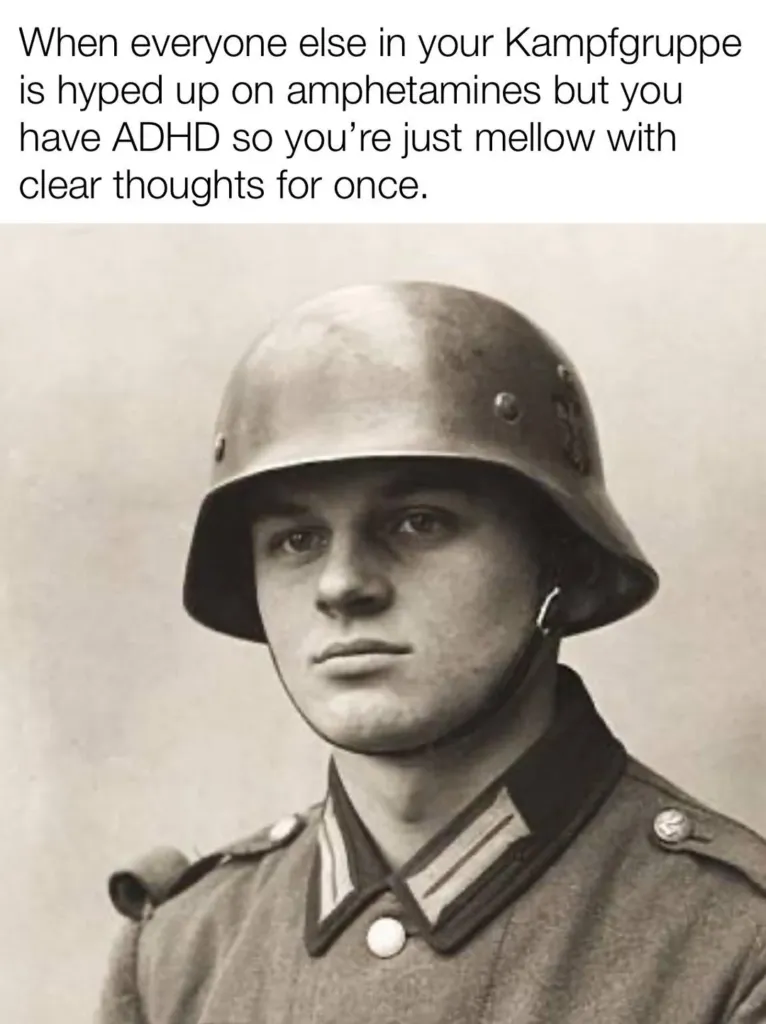
- It was used by Wehrmacht forces extensively during the Blitzkrieg campaigns against Poland and France in 1939–1940
- Pervitin remained available on prescription in Germany until 1988
The Deutschlandmuseum exhibition notes the standard presentation: a roll of 30 × 3 mg methamphetamine tablets — a delivery format identical in concept to a modern blister pack of prescription medication.
What Adderall Is
Adderall is a brand name for mixed amphetamine salts — a pharmaceutical formulation containing approximately 75% dextroamphetamine and 25% levoamphetamine, in a combination of four salt forms. It was approved by the FDA in the United States in the 1990s for ADHD treatment.
Adderall contains amphetamine — a compound in the same pharmacological family as methamphetamine, but chemically and pharmacologically distinct from it. The distinction matters significantly, as explained below.
The Chemistry: One Methyl Group, Significant Consequences
Methamphetamine and amphetamine share a nearly identical molecular structure. The difference is a single methyl group (one carbon atom plus three hydrogen atoms) attached to the nitrogen atom of amphetamine to form methamphetamine:
- Amphetamine (Adderall’s base): C9H13N
- Methamphetamine (Pervitin): C10H15N
This single structural addition produces pharmacologically meaningful consequences:
- Greater lipophilicity — the methyl group makes methamphetamine more fat-soluble, allowing it to cross the blood-brain barrier more rapidly and completely than amphetamine
- Faster CNS penetration — because it reaches the brain faster, the subjective onset of methamphetamine is quicker and more intense than amphetamine at equivalent doses
- Longer CNS half-life — methamphetamine is metabolised more slowly than amphetamine in the brain, producing longer-lasting effects
- Greater dopamine release — methamphetamine produces a larger, faster, and more sustained dopamine surge than amphetamine at the same dose
- Greater neurotoxicity — at recreational or above-therapeutic doses, methamphetamine produces dopamine depletion and structural damage to dopaminergic neurons not seen at equivalent amphetamine doses
Potency Comparison: How Much Stronger Was Pervitin?
This comparison requires distinguishing between different dimensions of “strength” — because potency, duration, dopamine release, and subjective intensity do not all scale identically.
Milligram-for-Milligram Potency
Methamphetamine is approximately 2–3 times more potent than amphetamine as a CNS stimulant per milligram. Clinical research comparing intranasal methamphetamine and d-amphetamine confirmed that methamphetamine produced greater subjective ratings of “good effects” and “drug strength” at equivalent doses.
This means a 3 mg Pervitin tablet (the standard dose) delivered roughly the equivalent CNS stimulant effect of approximately 6–9 mg of amphetamine. The recommended daily dose of 6–12 mg Pervitin would therefore deliver CNS stimulation roughly equivalent to 12–36 mg of amphetamine — overlapping with the therapeutic and upper therapeutic Adderall dose range at the high end.
Speed of Brain Penetration
Methamphetamine’s faster blood-brain barrier crossing produces a more rapid onset and more intense initial effect than amphetamine at equivalent doses. This is the mechanism most responsible for methamphetamine’s significantly higher addiction potential — the faster and more intense the dopamine spike, the more reinforcing the substance.
Pervitin tablets taken orally moderated this onset somewhat compared to smoked or injected methamphetamine — but the faster brain penetration compared to oral amphetamine still produced a more pronounced effect even by the oral route.
Duration
Pervitin’s effects lasted up to 11 hours per dose. Modern Adderall XR lasts 10–12 hours; Adderall IR lasts 4–6 hours. The per-dose duration was broadly comparable to modern extended-release formulations — though at a significantly higher dopamine intensity.
Dopamine Surge
Methamphetamine produces a substantially larger and faster dopamine release than amphetamine. Where therapeutic amphetamine produces a moderate, sustained elevation in prefrontal dopamine — sufficient to correct the ADHD deficit without producing euphoria in most ADHD patients — methamphetamine at equivalent doses produces a larger surge with more pronounced reward-circuit activation.
This is the functional difference between Pervitin’s reported effects in WWII accounts — euphoria, abolition of fatigue, feeling of invincibility, hours of sustained high-intensity activity — and the therapeutic focus-and-calm profile most ADHD patients experience on prescribed Adderall.
What Pervitin Did to WWII Soldiers
Historical and pharmacological records converge on a consistent picture of Pervitin’s effects on German military personnel:
Short-term effects (desired):
- Abolished feelings of fatigue — soldiers could march and fight for 3–4 days with minimal sleep
- Suppressed hunger and pain
- Produced euphoria and a feeling of confidence and capability
- Elevated aggression and combat effectiveness
Short-term effects (adverse):
- Paranoia — soldiers reported seeing enemies that weren’t there
- Impaired judgment — elevating recklessness with tactical consequences
- Cardiac stress — some soldiers died of heart failure
- Suicidal behaviour and fratricide — paranoia-driven incidents were documented
Long-term effects:
- Addiction was widespread — the Nobel Prize-winning author Heinrich Böll was among documented addicts
- Severe physical and psychological crash following cessation after prolonged use
- Long-term dopaminergic system damage consistent with methamphetamine’s known neurotoxicity
The National WWII Museum notes that Hitler himself received Pervitin as part of Dr. Theodor Morell’s pharmaceutical regimen — alongside cocaine, opioids, and other substances. The combination, used daily, produced the erratic mood swings — from euphoria to black depression — characteristic of stimulant-opioid cycling.
Pervitin vs. Adderall: The Direct Comparison
The Historical Context That Changes the Comparison
It is important to read the Pervitin comparison through its correct historical lens. The dose regimen and use context of Pervitin during WWII was not a therapeutic, titrated, medically monitored prescription — it was mass distribution to healthy soldiers to eliminate normal human fatigue limitations in combat, often without medical oversight, in doses calibrated for performance enhancement rather than disease treatment.
Historical research published in peer-reviewed journals notes that the use of Pervitin was not actually encouraged by the Nazi government at the highest level — the Reich Health Leader, Leonardo Conti, strongly discouraged its use, and the army physician corps frequently objected to distribution by field commanders. Its use was largely a bottom-up phenomenon driven by desperate field commanders rather than a top-down policy.
The picture that has become popular — entire Wehrmacht divisions sustained by methamphetamine — is a partial truth. Pervitin was distributed and used extensively in specific campaigns (particularly France 1940) but was not universally or continuously supplied throughout the war. The National WWII Museum specifically notes that the “Wehrmacht hooked on Pervitin” narrative requires significant qualification against the historical evidence.
Why Pervitin and Adderall Belong to Different Risk Categories
The reason this comparison matters pharmacologically — not just historically — is that it illustrates why drug class does not determine clinical equivalence.
Pervitin and Adderall are both stimulants. They both raise dopamine and norepinephrine. They both reduce fatigue and elevate alertness. And yet:
- Pervitin at its standard clinical doses produced euphoria, paranoia, suicidality, cardiac death, and widespread addiction among healthy users
- Adderall at therapeutic doses produces corrective attention improvement in ADHD patients without euphoria, with a manageable (though real) side effect profile, under sustained clinical oversight
The differences in compound (meth vs. amphetamine), dose calibration, blood-brain barrier penetration rate, and clinical context collectively produce categorically different risk profiles — not simply “more” or “less” of the same risk.
This is the same logic that distinguishes prescribed dexamphetamine from street methamphetamine in Australia today — same pharmacological family, different compound, different dose, different context, different risk profile.
Australian and Legal Context
Adderall is not available in Australia. The relevant Australian equivalents are dexamphetamine (pure dextroamphetamine, PBS-listed, Schedule 8) and Vyvanse(lisdexamfetamine, PBS-listed, Schedule 8). Both are amphetamines — in the same pharmacological family as Adderall but not methamphetamine.
Methamphetamine — the compound in Pervitin — is a Schedule 9 prohibited substance in Australia in all forms except the pharmaceutical product Desoxyn, which is not registered in Australia. Street methamphetamine (ice/crystal meth) is the same compound as Pervitin — pharmaceutical methamphetamine hydrochloride — manufactured clandestinely and without purity controls.
The pharmacological relationship between Pervitin and modern street methamphetamine is direct and unambiguous: they are the same compound. Pervitin was pharmaceutical methamphetamine; crystal meth is illicit methamphetamine. The difference is manufacture, purity, and dose control — not the molecule itself.
Common Misconceptions
Myth 1: “Pervitin was basically Adderall — soldiers were just on prescription ADHD meds.”Pervitin was methamphetamine; Adderall is amphetamine. They are related but distinct compounds with meaningfully different potency, blood-brain barrier penetration, dopamine surge magnitude, and neurotoxicity profiles. Calling Pervitin “basically Adderall” collapses a pharmacologically significant difference into an oversimplification.
Myth 2: “Pervitin was only 3 mg per tablet so it was mild.”Milligram numbers cannot be compared across different compounds without accounting for relative potency. Methamphetamine is 2–3 times more potent than amphetamine per milligram — a 3 mg methamphetamine dose has roughly the CNS stimulant equivalent of 6–9 mg amphetamine. The recommended 2–4 tablet daily dose delivered 6–12 mg methamphetamine — a significant stimulant load producing euphoria in healthy users.
Myth 3: “The Blitzkrieg was won by Pervitin.”The role of Pervitin in the 1940 French campaign is real and documented, but the “Pervitin won the war” narrative significantly overstates one contributing factor. The WWII Museum and academic historians note that the Wehrmacht’s success in France was driven primarily by tactical doctrine, operational surprise, and Allied failures — Pervitin facilitated soldier endurance in specific operations but was not a strategic determinant.
Myth 4: “Crystal meth today is different from Pervitin.”Chemically, they are the same compound — methamphetamine hydrochloride. Pervitin was pharmaceutical-grade methamphetamine in precisely dosed 3 mg tablets; crystal meth is clandestinely manufactured methamphetamine in variable-purity crystalline form. The molecule is identical; the manufacturing standards, purity, and dose certainty differ.
FAQ — How Strong Was Pervitin Compared to Adderall?
How strong was Pervitin compared to Adderall?Pervitin was significantly stronger — approximately 2–3 times more potent per milligram — because Pervitin was methamphetamine while Adderall is amphetamine. Beyond raw potency, methamphetamine crosses the blood-brain barrier faster, produces a larger and faster dopamine surge, and lasts longer, producing effects (including euphoria and abolition of fatigue) not present at Adderall’s therapeutic doses.
What exactly was Pervitin?Pervitin was a pharmaceutical methamphetamine product manufactured by German company Temmler-Werke from 1938. Each tablet contained 3 mg of methamphetamine hydrochloride. It was marketed as a general stimulant and fatigue remedy, became widely used by German civilians and military, and was distributed to Wehrmacht soldiers during the early campaigns of WWII. It is the same compound as modern crystal meth — the difference is pharmaceutical manufacture and dose precision.
Is Pervitin the same as modern crystal meth?Yes, chemically — both are methamphetamine hydrochloride. Pervitin was pharmaceutical-grade methamphetamine in precisely measured 3 mg tablets. Crystal meth is clandestinely manufactured methamphetamine in crystalline form, of variable purity. The molecule is identical; the source, purity, and dose control differ.
How does Adderall compare to methamphetamine generally?Methamphetamine is 2–3 times more potent per milligram, faster at crossing the blood-brain barrier, longer-acting, and produces a substantially larger dopamine surge with more pronounced euphoric and neurotoxic effects than amphetamine. Adderall (amphetamine) at therapeutic doses produces corrective dopamine elevation for ADHD without euphoria; methamphetamine at equivalent doses produces intense stimulant effects in both ADHD and non-ADHD users.
Did Pervitin help the Blitzkrieg?Pervitin was used extensively during the campaigns against Poland (1939) and France (1940), enabling soldiers to maintain activity and combat readiness for extended periods without sleep. Historical research supports a meaningful role in sustaining individual soldier endurance during these campaigns. However, peer-reviewed military history cautions against attributing the Blitzkrieg’s operational success primarily to Pervitin — tactical, strategic, and Allied command factors were more determinative.
Is dexamphetamine in Australia related to Pervitin?They are in the same pharmacological family — both are amphetamine-class stimulants — but dexamphetamine is amphetamine (d-isomer), not methamphetamine. Pervitin is methamphetamine, which is a distinct and more potent compound. The relationship is: dexamphetamine → amphetamine family; Pervitin/crystal meth → methamphetamine family. Both families are stimulants, but methamphetamine is meaningfully more potent and more dangerous.
The Bottom Line
Pervitin was pharmaceutical methamphetamine — and methamphetamine is approximately 2–3 times more potent than the amphetamine in Adderall, faster at crossing the blood-brain barrier, capable of producing euphoria and abolishing fatigue in healthy users at standard doses, and associated with addiction, paranoia, cardiac events, and neurotoxicity at the doses WWII soldiers were using. Adderall is a different compound — amphetamine, not methamphetamine — dosed therapeutically for ADHD correction rather than performance enhancement in healthy individuals, producing a corrective rather than euphoric effect in appropriately diagnosed patients. The comparison is not between two versions of the same drug — it is between two related members of the amphetamine family with meaningfully different potency, neurological impact, and clinical risk profiles. For Australians, Adderall is unavailable by law; dexamphetamine and Vyvanse are the legal amphetamine-class ADHD options, both pharmacologically closer to Adderall than to Pervitin.
How strong was Pervitin compared to Adderall Hobart
How strong was Pervitin compared to Adderall Devonport
How strong was Pervitin compared to Adderall Launceston
How strong was Pervitin compared to Adderall Tasmania
How strong was Pervitin compared to Adderall Victoria
How strong was Pervitin compared to Adderall Queensland
How strong was Pervitin compared to Adderall Canberra
How strong was Pervitin compared to Adderall Australian Capital Territory
How strong was Pervitin compared to Adderall South Australia
How strong was Pervitin compared to Adderall New South Wales
How strong was Pervitin compared to Adderall Darwin
How strong was Pervitin compared to Adderall Ghan
How strong was Pervitin compared to Adderall Northern Territory
How strong was Pervitin compared to Adderall Australia
How strong was Pervitin compared to Adderall Austria
How strong was Pervitin compared to Adderall Germany
How strong was Pervitin compared to Adderall United Kingdom
How strong was Pervitin compared to Adderall Sweden
How strong was Pervitin compared to Adderall Denmark
How strong was Pervitin compared to Adderall Norway
How strong was Pervitin compared to Adderall Finland
How strong was Pervitin compared to Adderall Iceland
How strong was Pervitin compared to Adderall Netherlands
How strong was Pervitin compared to Adderall Spain
How strong was Pervitin compared to Adderall Ireland
How strong was Pervitin compared to Adderall Switzerland
