
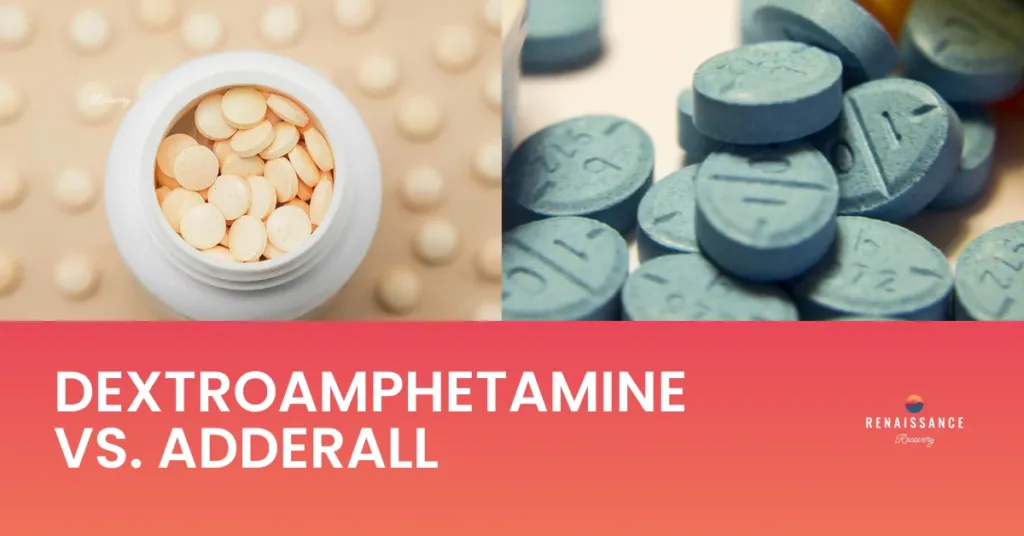
Yes — dextroamphetamine (sold as Dexedrine; available in Australia as dexamphetamine) is stronger than Adderall on a milligram-for-milligram basis. The reason is precise: Adderall is a mixture of 75% dextroamphetamine and 25% levoamphetamine, and levoamphetamine is 3–7 times less potent than dextroamphetamine as a central nervous system stimulant. Because dextroamphetamine is pure d-amphetamine with no less-potent levo-isomer diluting it, the same milligram dose delivers more active stimulant effect. The practical dose conversion is approximately 30 mg Adderall ≈ 25 mg dextroamphetamine.
Introduction
The question “is dextroamphetamine stronger than Adderall?” sits at the intersection of chemistry and clinical medicine — and the answer matters practically for anyone switching between the two, trying to understand why the same milligram number produces different effects, or asking why their prescriber has chosen one formulation over the other.
The answer requires understanding what Adderall actually contains, what the difference between dextroamphetamine and levoamphetamine is, and how their relative potency translates into real-world clinical effects. This guide gives you the full picture — including what “stronger” means clinically, when pure dextroamphetamine is the preferred choice, and how both medications are accessed in Australia.
What Adderall Actually Contains
Adderall is not pure dextroamphetamine — it is a mixed amphetamine salt formulation containing four amphetamine salt compounds in a fixed ratio:
- Amphetamine aspartate monohydrate — 25% of total
- Amphetamine sulfate — 25% of total
- Dextroamphetamine saccharate — 25% of total
- Dextroamphetamine sulfate — 25% of total
The net result of this blend is approximately 75% dextroamphetamine (d-amphetamine) and 25% levoamphetamine (l-amphetamine) by active isomer composition. This 3:1 ratio is why Adderall is sometimes described as “dextroamphetamine-predominant” — it is not pure dextroamphetamine.
Dextroamphetamine (Dexedrine/dexamphetamine), by contrast, contains only the d-isomer — 100% dextroamphetamine, no levoamphetamine component. This is the most fundamental difference between the two medications, and it is the source of the potency difference.
The Isomer Science: Why d-Amphetamine Is More Potent
Dextroamphetamine and levoamphetamine are mirror-image molecules — chemically identical atoms arranged in opposite spatial configurations (called enantiomers). Despite this structural similarity, they have meaningfully different pharmacological profiles in the human brain.
Dextroamphetamine (d-amphetamine):
- 2–7 times more potent than levoamphetamine as a dopamine and norepinephrine releaser in the central nervous system
- Has more pronounced CNS stimulant effects — more significant improvement in attention, executive function, and wakefulness
- Responsible for the primary therapeutic effect of all amphetamine-based ADHD medications
Levoamphetamine (l-amphetamine):
- 3.2–7 times less potent than dextroamphetamine as a dopamine reuptake inhibitor
- Has relatively greater peripheral (cardiovascular) activity compared to its central nervous system effects
- Lasts longer in the body than dextroamphetamine — a longer half-life that contributes to Adderall’s slightly extended duration profile compared to pure dextroamphetamine at equivalent doses
- Contributes to a somewhat smoother onset and offset in Adderall by extending and moderating the amphetamine concentration curve
- Carries a slightly higher rate of cardiovascular side effects relative to its CNS effect — heart racing and palpitation are more commonly associated with levoamphetamine
The scientific consensus, reflected in both pharmacology literature and clinical psychiatry guidance, is that dextroamphetamine is responsible for the vast majority of the therapeutic ADHD benefit in any amphetamine formulation, while levoamphetamine provides peripheral activation, slightly extended duration, and a moderating effect on the onset curve.
The Potency Difference: What It Means for Dosing
Because 25% of Adderall’s amphetamine content is the significantly less potent levoamphetamine, the effective “dextroamphetamine-equivalent” strength of a given Adderall dose is lower than the same number of milligrams of pure dextroamphetamine.
Approximate dose conversion:
A commonly used estimate based on the 3:1 isomer ratio and the 4x levoamphetamine potency difference is:
Dextroamphetamine equivalent≈Adderall dose×0.83
In practical terms: 30 mg Adderall ≈ approximately 25 mg dextroamphetamine in central nervous system effect. A 20 mg Adderall dose is approximately equivalent to 16–17 mg dextroamphetamine; a 10 mg Adderall dose is roughly equivalent to 8–9 mg dextroamphetamine.
This conversion is approximate — individual variation in how each person’s receptors respond to d- versus l-amphetamine means the conversion is not exact and re-titration is clinically necessary when switching. A prescriber will typically start the new medication at a conservative dose and titrate from there rather than applying the conversion formula precisely.
“Stronger” Does Not Mean “Better” — The Clinical Nuance
It is worth stating directly: being milligram-for-milligram stronger does not make dextroamphetamine the superior ADHD medication across all contexts. Strength is one dimension of clinical usefulness. The others — duration, side effect profile, the role of levoamphetamine in modulating the onset and offset curve — matter equally for real-world treatment outcomes.
Where dextroamphetamine’s greater potency is a clinical advantage:
- Patients who require a cleaner, more targeted CNS effect with less peripheral cardiovascular activation — since levoamphetamine contributes disproportionately to cardiovascular side effects relative to its therapeutic benefit
- Patients who are sensitive to anxiety and find Adderall’s levoamphetamine component amplifies peripheral arousal (heart racing, tension, restlessness)
- Patients who want to minimise total milligram dose to achieve therapeutic effect, which reduces proportional exposure to stimulant side effects
Where Adderall’s mixed-isomer composition is a clinical advantage:
- The levoamphetamine component extends the half-life and smooths the concentration curve, contributing to a slightly longer and more gradual offset compared to pure dextroamphetamine
- The broader dual-isomer coverage may provide better symptom control for patients whose ADHD presentations involve components that respond differently to d- and l-amphetamine pathways — which is part of why Adderall was specifically developed as a multi-salt formulation
- Some patients simply respond better clinically to the mixed formulation — individual neurochemistry determines which isomer ratio feels most therapeutically useful
Side Effects: How Purity Changes the Profile
The removal of levoamphetamine in pure dextroamphetamine has specific side effect consequences:
Side effects more common with Adderall (levoamphetamine-related):
- Elevated heart rate and palpitations — levoamphetamine has proportionally greater peripheral cardiovascular activity
- Agitation, restlessness, and excitability — reported more frequently with Adderall than with pure dextroamphetamine in clinical comparisons
- Physical anxiety — the peripheral sympathomimetic effects of levoamphetamine can produce physical anxiety symptoms disproportionate to the central therapeutic effect
Side effects of dextroamphetamine not modulated by levoamphetamine:
- Shorter duration relative to dose — without levoamphetamine’s longer half-life contribution, pure dextroamphetamine clears somewhat faster, which can mean a more pronounced afternoon drop
- The lack of a moderating levoamphetamine tail can make the offset less gradual than Adderall for some patients
Shared side effects (present with both, as both are amphetamine-class stimulants):
- Appetite suppression and weight loss
- Insomnia with late dosing
- Dry mouth
- Headaches
- Elevated blood pressure
- Potential for dependence
The clinical literature notes that side effects such as agitation, restlessness, excitability, anxiety, nausea, and stomach pain are reported more commonly with Adderall than with dextroamphetamine. This is consistent with levoamphetamine’s known peripheral activation profile.
When Dextroamphetamine Is the Better Clinical Choice
Based on the pharmacological and clinical evidence, dextroamphetamine is likely the stronger clinical choice in these specific contexts:
- You experience significant cardiovascular side effects on Adderall — rapid heart rate, palpitations, or chest tightness — that are disproportionate to your therapeutic benefit. Eliminating the levoamphetamine component removes the isomer most responsible for peripheral cardiovascular activation
- You experience significant anxiety, agitation, or restlessness on Adderall that is limiting the medication’s usefulness. Dextroamphetamine’s cleaner CNS profile without levoamphetamine’s peripheral arousal typically produces less anxiety at equivalent therapeutic effect
- You want to achieve equivalent therapeutic effect at a lower milligram dose — because dextroamphetamine is more potent mg-for-mg, a lower absolute dose may achieve the same benefit, reducing total stimulant exposure
- You have already tried Adderall with adequate efficacy but unacceptable side effects — dextroamphetamine preserves the d-amphetamine therapeutic mechanism while removing the l-amphetamine component driving the unwanted effects
When Adderall’s Mixed Formulation Is the Better Clinical Choice
Adderall’s 3:1 mixed isomer formulation is preferable in these contexts:
- You need slightly longer and more gradual duration of coverage — levoamphetamine’s longer half-life extends and smooths the medication’s concentration curve, providing a somewhat longer effective window and softer offset
- You have tried pure dextroamphetamine and found the offset too abrupt — some patients describe a sharper afternoon drop without the levoamphetamine tail to moderate it
- Adderall is currently working well for you — if therapeutic effect is good and side effects are manageable, there is no clinical rationale to switch to pure dextroamphetamine
- Adderall is not available in Australia — for most of the English-speaking world outside the United States, this point is academic since Adderall itself is not available; the available choice is between dexamphetamine, Vyvanse, and methylphenidate
The Full Comparison at a Glance
Australian Context: Dexamphetamine as the Practical Option
This comparison is particularly relevant to Australian readers because Adderall is not available in Australia — it is not TGA-approved and cannot be legally prescribed. Dexamphetamine is TGA-approved and PBS-listed in Australia, making it the most direct amphetamine-equivalent available.
Australian ADHD treatment with amphetamine-class medications therefore centres on the choice between dexamphetamine (pure d-amphetamine, available as 5 mg tablets on PBS) and Vyvanse (lisdexamfetamine, which converts entirely to dextroamphetamine in the body). Both deliver only the d-isomer — neither contains levoamphetamine. For Australian patients curious about Adderall’s specific effects, dexamphetamine is pharmacologically the closest available equivalent, with the primary difference being Adderall’s levoamphetamine component, which dexamphetamine does not have.
Dexamphetamine in Australia is a Schedule 8 controlled substance requiring specialist (psychiatrist or paediatrician) prescription, and in some states a specific permit from the prescribing physician. Patients cannot be prescribed it by a GP without specialist involvement.
Common Misconceptions
Myth 1: “Stronger means I should ask for dextroamphetamine instead of Adderall.”Milligram-for-milligram potency is not a reason to prefer one medication over another — it’s a factor in dose calibration. Both can be titrated to the same therapeutic effect at different milligram numbers. The clinical decision is based on side effect profile, duration preference, and individual response — not which one sounds more powerful.
Myth 2: “The levoamphetamine in Adderall is completely useless.”Levoamphetamine has a genuine role in Adderall’s clinical profile — it extends the half-life, moderates the concentration curve, and provides a softer onset and offset than pure dextroamphetamine. It is less potent as a CNS stimulant but it is not pharmacologically inert, and for some patients the smoother Adderall profile is clinically preferable.
Myth 3: “Dextroamphetamine and Vyvanse are the same medication.”Both deliver dextroamphetamine as the active agent, but through very different mechanisms. Vyvanse is a prodrug requiring enzymatic conversion that creates a highly gradual, rate-limited release — producing a much smoother onset, longer duration, and softer offset than dextroamphetamine IR. They are not interchangeable, and they do not feel the same in clinical practice.
Myth 4: “Adderall is available in Australia if I have a US prescription.”Adderall is not TGA-approved and importing it — regardless of prescription status — is illegal under Australian border control regulations. Australian patients with valid clinical need for amphetamine-class ADHD treatment have legal, effective, PBS-listed options in dexamphetamine and Vyvanse that are accessible through specialist prescription.
FAQ — Is Dextroamphetamine Stronger Than Adderall?
Is dextroamphetamine stronger than Adderall?Yes — milligram-for-milligram, dextroamphetamine is more potent than Adderall. Adderall contains 25% levoamphetamine, which is 3–7 times less potent than dextroamphetamine as a CNS stimulant. Because dextroamphetamine is 100% d-isomer with no less-potent component, the same dose number delivers more total active stimulant effect.
What is the dose conversion between dextroamphetamine and Adderall?The approximate conversion is 30 mg Adderall ≈ 25 mg dextroamphetamine. This is derived from the 3:1 isomer ratio and the approximately 4x potency differential between d- and l-amphetamine. This conversion is approximate — individual variation in isomer sensitivity is significant, and any switch should involve prescriber-guided re-titration rather than direct dose conversion.
Is dextroamphetamine better than Adderall for ADHD?Not universally — it depends on the individual’s response profile. Dextroamphetamine is likely better for patients experiencing cardiovascular side effects, anxiety, or agitation on Adderall that are driven by the levoamphetamine component. Adderall’s mixed formulation may be better for patients who benefit from levoamphetamine’s longer half-life producing a softer, more gradual offset. Individual response determines clinical superiority more reliably than isomer pharmacology.
What is the difference between dextroamphetamine and levoamphetamine?Dextroamphetamine and levoamphetamine are mirror-image molecules (enantiomers) of the same base amphetamine compound. Dextroamphetamine is 3–7 times more potent as a CNS stimulant — producing more pronounced effects on dopamine and norepinephrine in the brain. Levoamphetamine has proportionally greater peripheral (cardiovascular) activity and a longer half-life, contributing more to heart rate elevation and providing a more extended duration than its CNS contribution alone would suggest.
Why did Adderall include levoamphetamine if dextroamphetamine is more potent?The inclusion of levoamphetamine was intentional in Adderall’s development — the mixed-salt formulation was designed to produce a clinical profile that the pure dextroamphetamine of Dexedrine did not. Levoamphetamine’s longer half-life smooths and extends the concentration curve, providing a more gradual offset and potentially broader symptom coverage for ADHD presentations that respond better to the combined isomer profile. The 3:1 ratio was selected to maximise the d-isomer’s therapeutic CNS effect while retaining l-isomer’s duration-extending properties.
Is dextroamphetamine available in Australia?Yes — dexamphetamine (the Australian spelling) is TGA-approved and PBS-listed in Australia as 5 mg tablets. It is a Schedule 8 controlled substance requiring specialist prescription — typically from a psychiatrist or paediatrician, with state-specific permit requirements for some prescribers. Adderall is not available in Australia and cannot be legally imported or prescribed.
How does dextroamphetamine compare to Vyvanse?Both dextroamphetamine and Vyvanse deliver dextroamphetamine as the final active agent in the brain — but through radically different delivery mechanisms. Dextroamphetamine IR is immediately active upon absorption, producing a faster onset and shorter duration (4–6 hours). Vyvanse requires enzymatic conversion that rate-limits its activation, producing a slow, smooth onset over 60–90 minutes and a sustained duration of 10–14 hours. Dextroamphetamine IR is better for controlled, shorter windows of coverage; Vyvanse is better for consistent all-day coverage.
The Bottom Line
Dextroamphetamine is milligram-for-milligram stronger than Adderall because Adderall contains 25% levoamphetamine — an isomer 3–7 times less potent than dextroamphetamine as a central nervous system stimulant. The practical dose conversion is approximately 30 mg Adderall ≈ 25 mg dextroamphetamine, and any switch requires prescriber-guided re-titration. Greater potency does not make dextroamphetamine universally superior — Adderall’s levoamphetamine component contributes a longer half-life and smoother offset that some patients depend on, and some respond better to the mixed-isomer profile. For patients experiencing cardiovascular side effects or anxiety on Adderall, switching to pure dextroamphetamine removes the isomer most responsible for peripheral arousal while preserving the CNS therapeutic mechanism. For Australian patients, Adderall is unavailable by law; dexamphetamine is the directly equivalent option and is PBS-listed for access through specialist prescription.
Is dextroamphetamine stronger than Adderall Hobart
Is dextroamphetamine stronger than Adderall Devonport
Is dextroamphetamine stronger than Adderall Launceston
Is dextroamphetamine stronger than Adderall Tasmania
Is dextroamphetamine stronger than Adderall Victoria
Is dextroamphetamine stronger than Adderall Queensland
Is dextroamphetamine stronger than Adderall Canberra
Is dextroamphetamine stronger than Adderall Australian Capital Territory
Is dextroamphetamine stronger than Adderall South Australia
Is dextroamphetamine stronger than Adderall New South Wales
Is dextroamphetamine stronger than Adderall Darwin
Is dextroamphetamine stronger than Adderall Ghan
Is dextroamphetamine stronger than Adderall Northern Territory
Is dextroamphetamine stronger than Adderall Australia
Is dextroamphetamine stronger than Adderall Austria
Is dextroamphetamine stronger than Adderall Germany
Is dextroamphetamine stronger than Adderall United Kingdom
Is dextroamphetamine stronger than Adderall Sweden
Is dextroamphetamine stronger than Adderall Denmark
Is dextroamphetamine stronger than Adderall Norway
Is dextroamphetamine stronger than Adderall Finland
Is dextroamphetamine stronger than Adderall Iceland
Is dextroamphetamine stronger than Adderall Netherlands
Is dextroamphetamine stronger than Adderall Spain
Is dextroamphetamine stronger than Adderall Ireland
Is dextroamphetamine stronger than Adderall Switzerland
